
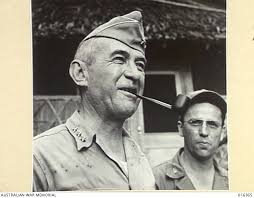
Camp Columbia at Wacol was more than a transit and training camp. For a crucial period in early 1943 it functioned as a command site, hosting the headquarters of the U.S. Sixth Army at a decisive moment in the Pacific War. At the centre of this headquarters story was Lieutenant General Walter Krueger, one of the most important yet least publicly recognised senior commanders in the Southwest Pacific.
Krueger’s presence at Camp Columbia places the site firmly within the Allied command structure that supported General Douglas MacArthur’s campaign northwards through New Guinea and, later, the Philippines.
Establishing Sixth Army Headquarters At Camp Columbia
The U.S. Sixth Army headquarters arrived in Australia in February 1943. Its forward administrative base was established at Camp Columbia, approximately ten miles west of Brisbane, selected for its space, access to transport infrastructure, and proximity to the wider Allied command and logistics network developing around Brisbane.
A rare first-hand account of this moment comes from Lt. Mark Muller, a Signal Officer with Base Section 3. Muller was tasked with establishing the headquarters’ communications infrastructure—telephone, teletype and messenger services—essential for a functioning field army command. His autobiography describes poles being erected, field wire strung across the site, and the communications centre taking shape as the operational nerve centre of Sixth Army.
While inspecting the work, Muller unexpectedly encountered Krueger in person. The general introduced himself informally and showed direct interest in the progress of the headquarters installation. This brief encounter confirms Krueger’s physical presence at Camp Columbia during the headquarters establishment phase and reflects his hands-on approach to command.
Krueger’s Leadership Style At Camp Columbia
Krueger was known among his staff and subordinates as a disciplined, professional soldier rather than a flamboyant figure. Muller’s recollections reinforce this reputation. He describes Krueger as warm, approachable and deeply respectful of both officers and enlisted personnel.
One striking leadership practice stood out: Krueger deliberately invited a different officer or enlisted man to dine at his mess each evening, a habit he maintained throughout the war. In the context of a vast, dispersed theatre such as the Southwest Pacific, this was not a social gesture alone. It was a means of staying connected to the realities faced by his troops and maintaining trust across ranks.
Muller later described Krueger’s staff as the most professional he had encountered, and Krueger himself as an outstanding leader and a true gentleman. These qualities mattered at Camp Columbia, where planning, coordination and communication were as decisive as combat operations at the front.
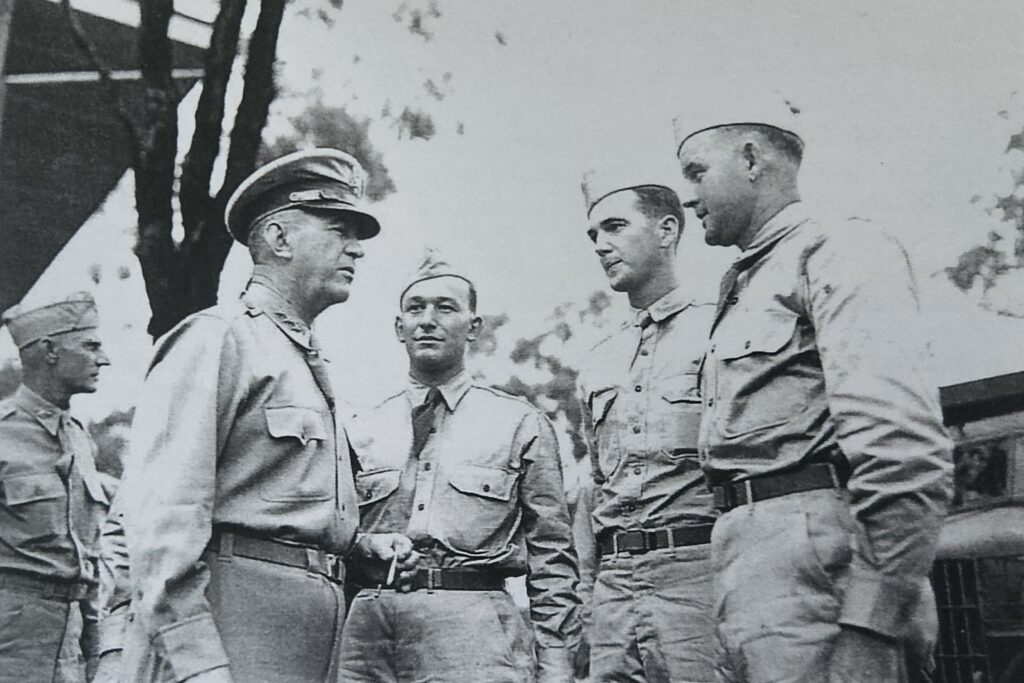
US Sixth Army, speaking to graduates of the Officers’ Candidate
School after their graduation ceremony at Camp Columbia,
Somewhere in Australia. Left to right: General Krueger,
Second Lieuts Jerome Friedman, Bronx, NY: Donald Henry, of Seymour, Md: and Woodrew Harrison of Clalborn, M.d.
Photo by US Army Signal Corps. The Newcastle Sun, Wednesday 14 April 1943.
Camp Columbia As A Working Command Environment
Muller’s account also places Sixth Army headquarters within the broader Camp Columbia landscape. Only a short distance from headquarters stood the 152nd Field Hospital, operating under extremely basic conditions in tents, with limited communications and transport access.
The proximity of command headquarters, signals units and medical facilities highlights Camp Columbia’s integrated wartime function. It was a working military environment where decisions made at headquarters directly affected medical care, logistics and operational readiness. Improvements to communications, coordinated through headquarters channels, could materially change conditions on the ground.
This integrated character is confirmed by Queensland wartime records, which identify Camp Columbia as hosting not only Sixth Army headquarters but also extensive medical, training and support facilities.
From Camp Columbia To The Pacific Front
Krueger’s time at Camp Columbia was foundational rather than permanent. As Allied operations advanced northward, Sixth Army headquarters moved forward to New Guinea, and Camp Columbia transitioned to other roles, including later use by the Netherlands East Indies government-in-exile.
From the headquarters first established at Camp Columbia, Krueger went on to command Sixth Army through major campaigns in New Guinea and the Philippines. His headquarters structure—often operating simultaneously as Sixth Army and as the operational task force known as “Alamo Force”—was complex and demanding, yet proved effective in sustaining the momentum of MacArthur’s campaign.
Krueger ultimately commanded Sixth Army into the Philippines and later into occupation duties in Japan, concluding one of the most operationally significant commands of the Pacific War.
Why Krueger Matters To Camp Columbia’s History
General Walter Krueger matters to Camp Columbia for three key reasons.
First, his presence confirms Camp Columbia’s status as a genuine Allied command site, not merely a staging or accommodation area.
Second, his leadership style—professional, restrained and attentive to people—helps humanise the site’s history. Through first-hand testimony, Camp Columbia becomes a place of real decision-making and lived experience, not just maps and timelines.
Finally, Krueger’s relative absence from popular memory makes his story particularly important for interpretation. Camp Columbia allows visitors to understand that the Pacific War was shaped not only by famous personalities but also by professional commanders whose work turned strategy into reality.
Further Reading And Sources
Lt. Mark Muller, autobiography, Signal Officer Base Section 3
Queensland Government WWII Historic Places Register: Camp Columbia (Wacol)
Camp Columbia Heritage Association: Sixth Army establishment and site timelines
Cushing Memorial Library & Archives (Texas A&M): General Walter Krueger Papers
Australian Army Research Centre: Studies on Krueger’s operational command
U.S. Army historical studies on Sixth Army and Alamo Force