
The military service records of Willy Erkelens provide a remarkable insight into the international wartime and postwar networks connected to Camp Columbia and the wider Wacol military area in Brisbane. His career linked the Netherlands East Indies (NEI), Australia, the United States, New Guinea and postwar Indonesia through Allied military aviation during and after the Second World War.
Records from the archives of Bronbeek demonstrate how Camp Columbia and Wacol formed part of a much larger Allied wartime system involving Dutch military reorganisation, aviation training and postwar operations across the Pacific region.
Early life in the Netherlands East Indies
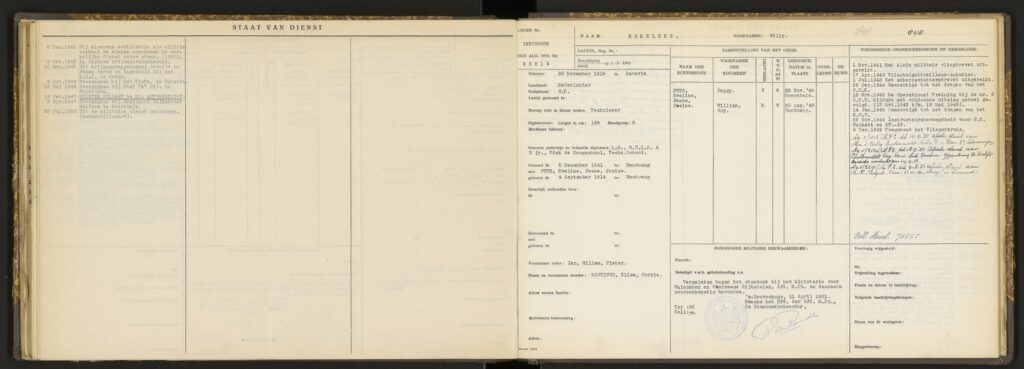
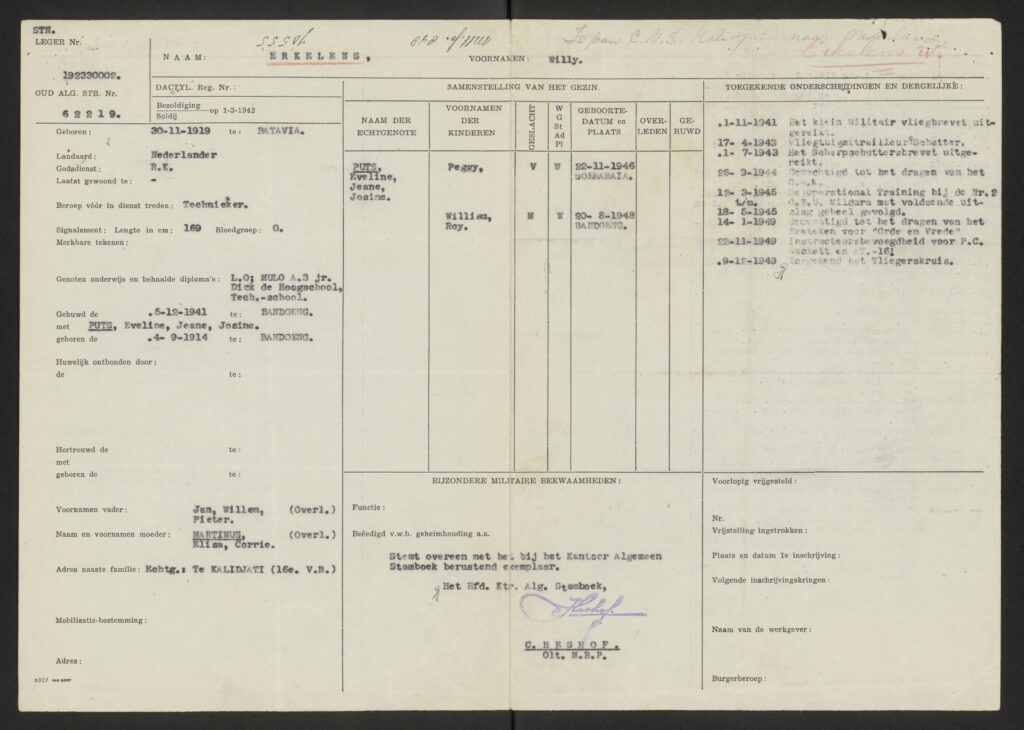
Willy Erkelens was born in Batavia on 30 November 1919. His service records describe him as a trained technician who completed MULO education, attended Dick de Hoogeschool and undertook three years of technical schooling.
Before the outbreak of war in the Pacific he entered military service in the colonial armed forces of the Netherlands East Indies.
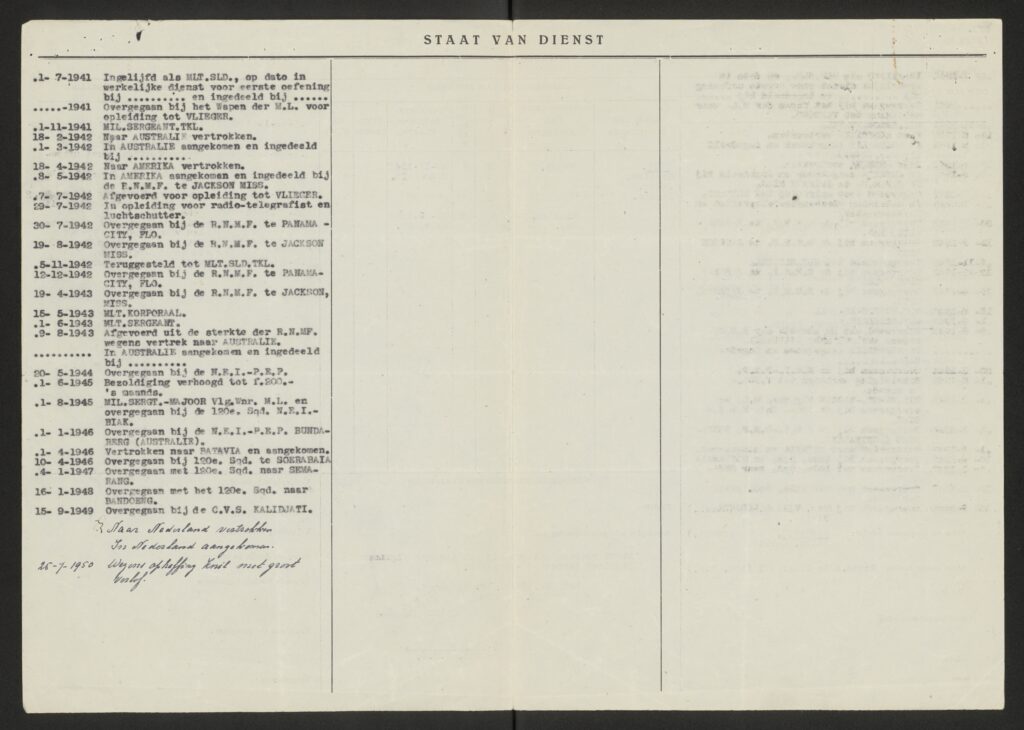
On 1 July 1941 he enlisted as a militia soldier and entered active service for military training. Soon afterwards he was assigned to aviation-related instruction.
The documents show that on 1 November 1941 he became a military sergeant second class and commenced pilot training.
Only weeks later, on 5 December 1941, he married Eveline Jeane Josine Puts in Bandung, just days before the Pacific War spread across Southeast Asia. The couple later had children including Peggy, William and Roy.
Escape from the collapsing Netherlands East Indies
Unlike many Dutch servicemen who became prisoners of war following the Japanese invasion, Erkelens escaped the collapsing Netherlands East Indies and became part of the Dutch military aviation rebuilding effort overseas.
The records show that on 18 February 1942 he departed for Australia. By 1 March 1942 he had arrived in Australia and was incorporated into Dutch military aviation structures operating there.
At this stage Australia had become a major refuge and operational base for Dutch military personnel escaping the Japanese advance through Southeast Asia.
Brisbane and Queensland would soon become central to these activities.
Allied aviation training in America
One of the most important aspects of the records is Erkelens’ extensive aviation training in the United States.
On 18 April 1942 he departed for America and on 8 May 1942 he was attached to the Royal Netherlands Military Flying School (RNMFS) at Jackson, Mississippi.
The RNMFS was one of the most important Dutch wartime aviation institutions established outside occupied Dutch territory. Supported by the United States Army Air Forces, it trained Dutch pilots and aviation personnel for Allied operations during the war.
The records document a series of increasingly specialised aviation training courses:
- pilot training;
- radio-telegraphist training;
- aerial gunnery;
- parachutist qualifications;
- military observer training.
He also trained at Panama City, Florida, including at Gunnery School No. 6.
These entries demonstrate how Dutch wartime aviation became integrated into wider Allied aviation systems after the collapse of the NEI.
Return to Australia
On 9 August 1943 Erkelens departed the strength of the RNMFS and returned to Australia.
This period coincided with the rapid expansion of Dutch military and governmental activities centred around Brisbane and Camp Columbia.
Originally established by the United States Army, Camp Columbia at Wacol became closely associated with the Netherlands East Indies Government-in-Exile after the Dutch took over sections of the camp in 1944.
The wider Wacol area contained accommodation camps, administration centres, training facilities and aviation-related activities connected to Dutch Army, Navy and Air Force personnel.
The records show that on 20 May 1944 Erkelens became attached to the N.E.I.-P.E.P. structure operating from Australia.
Brisbane as a Dutch wartime and postwar hub
The service record of Willy Erkelens reinforces the importance of Brisbane and Wacol as international military centres during and after the war.
Following the collapse of the Netherlands East Indies in 1942, Australia became a major refuge and operational base for Dutch military and civilian organisations. Brisbane in particular emerged as a critical Allied command and logistics centre in the Southwest Pacific.
Camp Columbia played a major role in this process. From here, the Netherlands East Indies Government-in-Exile coordinated military, administrative and political activities linked to the Dutch war effort and later to postwar operations in Indonesia.
Dutch military aviation also became closely connected to Australia. Personnel moved through training and operational facilities in Queensland while the Dutch attempted to rebuild military capability after liberation from Japanese occupation.
120 Squadron and the Southwest Pacific
One of the most historically significant entries in the file records that on 1 August 1945 Erkelens was transferred to 120 Squadron NEI RAAF at Biak.
No. 120 (Netherlands East Indies) Squadron represented one of the most important Dutch–Australian wartime aviation collaborations. The fighter squadron operated under Royal Australian Air Force command while maintaining Dutch personnel and identity.
Equipped with P-40 Kittyhawk aircraft, the squadron played an active operational role in the Southwest Pacific campaign.
The posting of Erkelens to 120 Squadron directly connects him to this important Allied military cooperation between Australia and the Netherlands.
Return to Indonesia after WWII
After the Japanese surrender, Erkelens returned to the Netherlands East Indies during the increasingly unstable postwar period.
The records show that on 1 January 1946 he was attached to Dutch military structures in Bundaberg, Australia, before departing for Batavia on 1 April 1946.
Subsequent postings included:
- Soerabaja (Surabaya);
- Bandung;
- Kalidjati airbase.
These assignments occurred during the Indonesian War of Independence, when Dutch military personnel became involved in efforts to restore Dutch authority following Indonesia’s declaration of independence in August 1945.
The records therefore place Erkelens within the broader military aviation environment of the postwar decolonisation conflict.
The Indonesian conflict and military aviation
The significance of Erkelens’ wartime career extends beyond Australia.
His name also appears in the DACC article Foreign pilots, Dutch blockades and the Indonesian air war: the Jogja Incident of 29 July 1947.” This places him within the wider military aviation operations connected to the Indonesian War of Independence.
After WWII the Dutch attempted to re-establish colonial authority in Indonesia, while Indonesian nationalists fought for independence. Aviation became a key component of Dutch military operations during this conflict.
The inclusion of Erkelens within this broader history highlights how many Dutch servicemen connected to Camp Columbia and Wacol later became involved in the difficult and controversial transition from colonial rule to Indonesian independence.
It also reinforces the role of Australia — and particularly Brisbane and Wacol — as military and logistical hubs linking the Allied war against Japan with the postwar conflict in Indonesia.
Wacol and postwar aviation training
The records also reveal a continuing connection between Erkelens and Wacol.
On 22 November 1949 he received instructor qualifications connected to P.C. Wacol and the AT-16 training aircraft.
The AT-16 was the Dutch designation for the North American AT-6 Texan advanced trainer aircraft, widely used in postwar pilot training.
This reference highlights the continuing importance of Queensland and Wacol within Dutch military aviation networks after WWII.
Decorations and distinctions
The service records contain numerous references to aviation qualifications and military decorations.
These include:
- Klein Militair Vliegbrevet;
- military observer qualification;
- parachutist brevet;
- aerial gunner qualification.
Most notably, on 9 December 1949 Erkelens was awarded the Dutch Vliegerkruis (Flying Cross), a distinguished military aviation decoration recognising courage, perseverance and skill during operational flying service.
The records also note that he received the Oorlogsherinneringskruis (War Memorial Cross) connected to wartime service.
The end of the KNIL era
One handwritten note records that Erkelens later returned to the Netherlands and was honourably discharged following the abolition of the KNIL:
“Wegens opheffing KNIL met goed verlof.”
This short entry reflects a major historical transition.
The KNIL — the Royal Netherlands East Indies Army — had existed for more than a century as the colonial military force of the Dutch East Indies. Following Indonesian independence, the KNIL was formally dissolved in 1950.
For many Dutch servicemen, this marked the end not only of military careers but also of an entire colonial world that disappeared during and after WWII.
Camp Columbia within an international wartime network
The military service records of Willy Erkelens reinforce the broader historical importance of Camp Columbia and the Wacol military area.
They demonstrate that Camp Columbia was not simply a local military installation, but part of an international wartime network linking:
- the Netherlands East Indies;
- Australia;
- the United States;
- New Guinea;
- and postwar Indonesia.
Through Dutch aviation training, military administration and operational deployments, places such as Wacol became deeply connected to the wider Allied war effort and the complex postwar transition that followed.
The story of Willy Erkelens therefore represents not only an individual military career, but also a broader chapter in the shared wartime heritage of Australia, the Netherlands and Indonesia.ual military career, but also a broader chapter in the shared wartime heritage of Australia, the Netherlands and Indonesia.
With thanks to researcher Michael Kramer (May 2026)