
The military service record of Marinus Willem Reith provides a fascinating insight into the international wartime networks connected to Camp Columbia and the wider Wacol military area in Brisbane. His file traces a career that moved from the Netherlands East Indies (NEI) to Australia, the United States and eventually back into postwar Indonesia during the turbulent years of decolonisation.
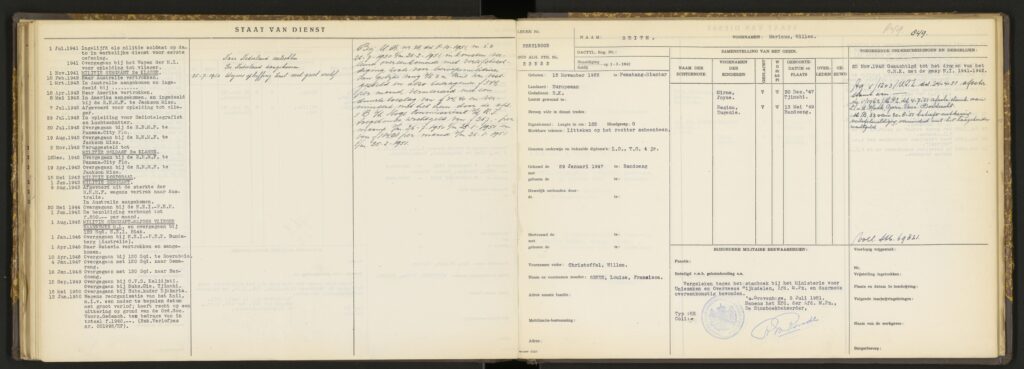
Unlike many Dutch servicemen whose wartime service remained largely regional, Reith’s record from the archives in Bronbeek (below)reveals a truly international military trajectory involving Allied aviation training across several countries. His story also demonstrates the crucial role that Australia — and particularly Wacol and Camp Columbia — played in rebuilding Dutch military capacity after the collapse of the Netherlands East Indies in 1942.
Early life in the Netherlands East Indies
Marinus Willem Reith was born on 15 November 1920 in Pematang-Siantar, Sumatra, in the former Netherlands East Indies. His service record identifies him as a European Dutch subject and notes that he completed primary education and four years of technical schooling.
Before the war he entered military service in the colonial armed forces of the NEI. On 1 July 1941 he enlisted as a militia soldier and entered active service shortly afterwards.
At that stage few could have anticipated the rapid collapse of Dutch colonial authority that would follow the Japanese offensive across Southeast Asia only months later.
Escape from the Netherlands East Indies
The record shows that Reith became involved in military aviation during the final months before the Japanese conquest.
On 1 November 1941 he attained the rank of military sergeant second class. Following the Japanese invasion, he departed Australia on 18 February 1942 and arrived in Australia and New Guinea in early March 1942.
This movement reflects the chaotic evacuation of Dutch military personnel during the final stages of the NEI campaign. Many Dutch air force and naval personnel escaped southward through Australia as Allied resistance in the Indies collapsed.
Unlike thousands of others, Reith avoided Japanese captivity and instead became part of the rebuilding of Dutch military aviation abroad.
Allied aviation training in Australia and the United States
One of the most remarkable aspects of Reith’s military file is the extensive aviation training he received through Allied cooperation.
On 18 April 1942 he travelled to America and was assigned to the Royal Netherlands Military Flying School (RNMFS) at Jackson, Mississippi. This was part of a major Allied pilot-training programme established in cooperation with the United States.
The RNMFS became one of the most important Dutch wartime aviation institutions outside Europe and the Netherlands East Indies. Dutch airmen trained there alongside other Allied personnel using American aircraft and instructors.
Reith’s file records a steady progression through aviation training:
- observer training;
- radio-telegraphy instruction;
- aerial gunnery training;
- operational aviation preparation.
He trained at several American facilities, including Gunnery School No. 6 at Panama City, Florida.
These entries demonstrate the extent to which Dutch wartime aviation had become integrated into wider Allied military systems after the fall of the NEI.
Connection to Australia and Camp Columbia
Australia remained central to Dutch wartime operations throughout Reith’s service.
On 9 August 1943 he departed the strength of the RNMFS and returned to Australia. The record later shows that he continued serving within Dutch aviation units connected to Australian operations.
On 20 May 1944 he arrived in Australia again and became attached to the N.S.I.-P.E.P. structure. This period coincided with the major expansion of Dutch military and governmental activities centred around Brisbane and Camp Columbia.
Camp Columbia at Wacol had originally been established by the United States Army but became closely linked to the Netherlands East Indies Government-in-Exile after the Dutch took over sections of the camp in 1944.
The broader Wacol area became a hub for Dutch military administration, accommodation, logistics and training. Dutch Army, Navy and Air Force personnel moved through the area during and after the war.
The record also shows that on 1 August 1945 Reith was transferred to 120 Squadron NEI at Biak. No. 120 (Netherlands East Indies) Squadron was a joint Dutch–Royal Australian Air Force fighter squadron formed in Australia during the war. Equipped with P-40 Kittyhawk aircraft, the squadron operated under RAAF command while retaining Dutch personnel and identity.
This places Reith directly within one of the most important Dutch–Australian wartime aviation collaborations.
Return to the Netherlands East Indies
After the Japanese surrender, Reith departed Australia for Batavia on 1 April 1946.
Like many Dutch servicemen returning from Australia, he entered an increasingly unstable political and military situation. Indonesian nationalists had proclaimed independence in August 1945 and conflict between Dutch forces and the Indonesian Republic intensified rapidly.
The service record traces several subsequent postings:
- Soerabaja (Surabaya);
- Semarang;
- Djokjakarta (Yogyakarta);
- later postings connected to military aviation administration.
These entries reflect the fluid and often dangerous conditions during the Indonesian War of Independence.
Decorations and aviation service
Reith’s aviation career was formally recognised through several distinctions.
Most notably, on 25 November 1948 he became entitled to wear the Dutch Oorlogs Herinnerings Kruis (War Memorial Cross) with the 1941–1942 clasp.
His record also indicates extensive operational aviation service and ongoing advancement through Dutch military aviation ranks.
The file notes that he married Mirna Joyce Regina Eugénie in Bandoeng (Bandung) on 29 January 1947. The couple later had children during the difficult postwar years.
A Dutch–Australian wartime story
The service record of Marinus Willem Reith highlights the highly international character of the Dutch wartime experience.
His career connected:
- the Netherlands East Indies;
- Australia;
- New Guinea;
- the United States;
- Allied aviation training systems;
- and the postwar conflict in Indonesia.
For the Camp Columbia Heritage Association, records such as these demonstrate the broader significance of Brisbane and Wacol during WWII. Camp Columbia was not merely a local military installation. It formed part of a global Allied wartime network linking military operations, training, logistics and government administration across multiple continents.
The story of Marinus Willem Reith also illustrates the close wartime cooperation between Dutch and Australian military forces, particularly in aviation. Through units such as 120 Squadron and through the Dutch presence in Brisbane and Wacol, these connections became an important part of the shared wartime heritage of Australia, the Netherlands and Indonesia.
Research with thanks to Michael Kramer (May 2026)