
Aboriginal presence, war and the reuse of the Camp Columbia landscape
Long before the establishment of Camp Columbia during the Second World War, Aboriginal people lived in and moved through the Wacol–Goodna area for thousands of years. While there are no confirmed archaeological records of permanent campsites or ceremonial grounds on the specific site later occupied by Camp Columbia, the absence of such records should not be interpreted as evidence of non-use. Much of the area was later heavily altered by military construction and post-war redevelopment.
In his book Aboriginal Campsites of Greater Brisbane historian Dr.Ray Kerkhove documented traditional Aboriginal camps across the Brisbane region, including a campsite in the Goodna area, identified as the closest known camp to Wacol. This research situates the Camp Columbia area within a broader Aboriginal landscape rather than as an isolated site.
In parallel, personal interviews conducted by Camp Columbia researchers with Aboriginal Elders identified the area that later became Camp Columbia as part of a wider cultural and economic landscape. According to this Aboriginal knowledge, the land was used for hunting across the plains leading down to the Brisbane River, where fishing also formed an important part of subsistence and seasonal movement. These patterns of use often leave limited archaeological traces, particularly in areas later subject to intensive development.
Following the end of the war, Camp Columbia and its surrounding sites entered a new phase. Former wartime accommodation was repurposed to address Brisbane’s acute housing shortage. Wacol became a housing camp managed by the Queensland Housing Commission, accommodating a mixed population that included migrants, Aboriginal families and economically marginalised Australian-born residents.
Contemporary newspaper archived in Trove (see below) reporting confirms Aboriginal residence at Wacol during this period. In October 1953, the Courier-Mail reported on Mr Cyril Richards, identified as living at the Wacol housing camp, who spoke publicly about the difficulties faced by Aboriginal people attempting to enter urban employment and civic life. His experience illustrates the challenges faced by Aboriginal residents navigating post-war Brisbane under assimilation-era policies.
The Richards Family at Wacol
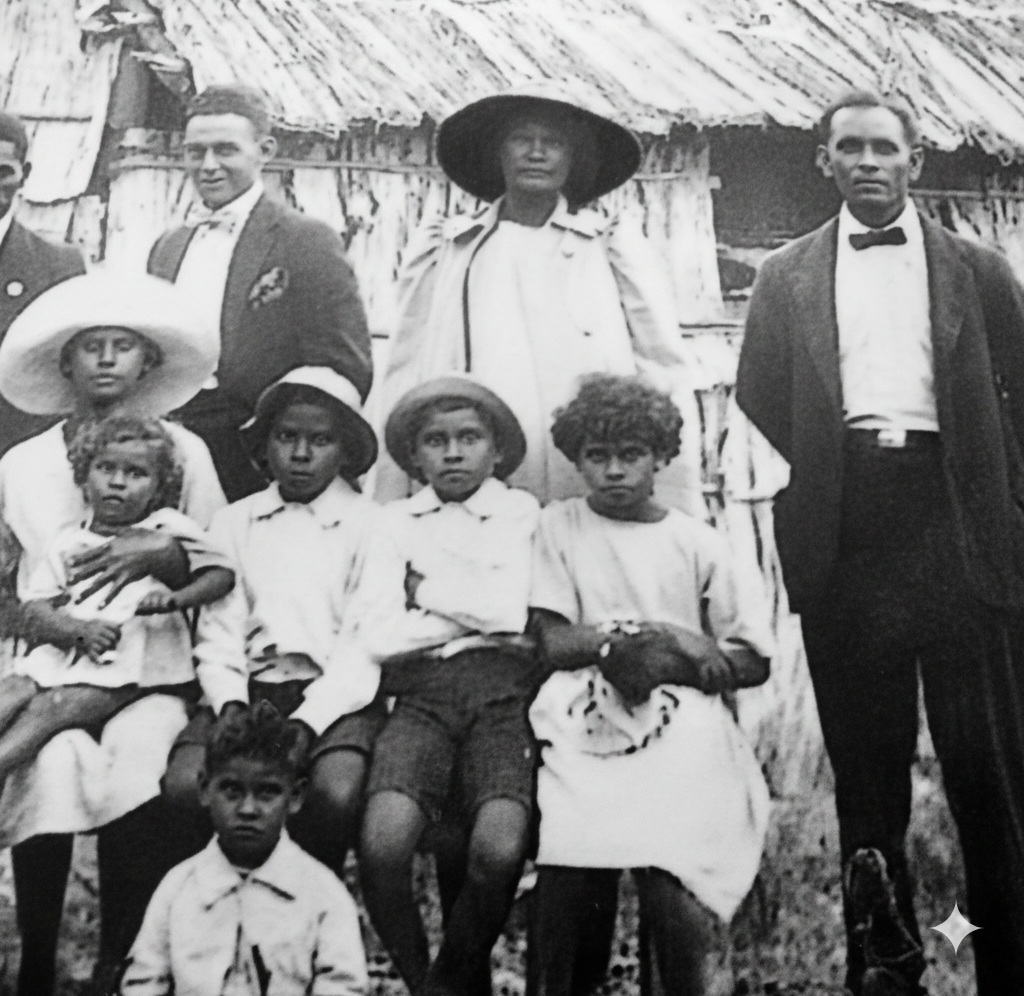
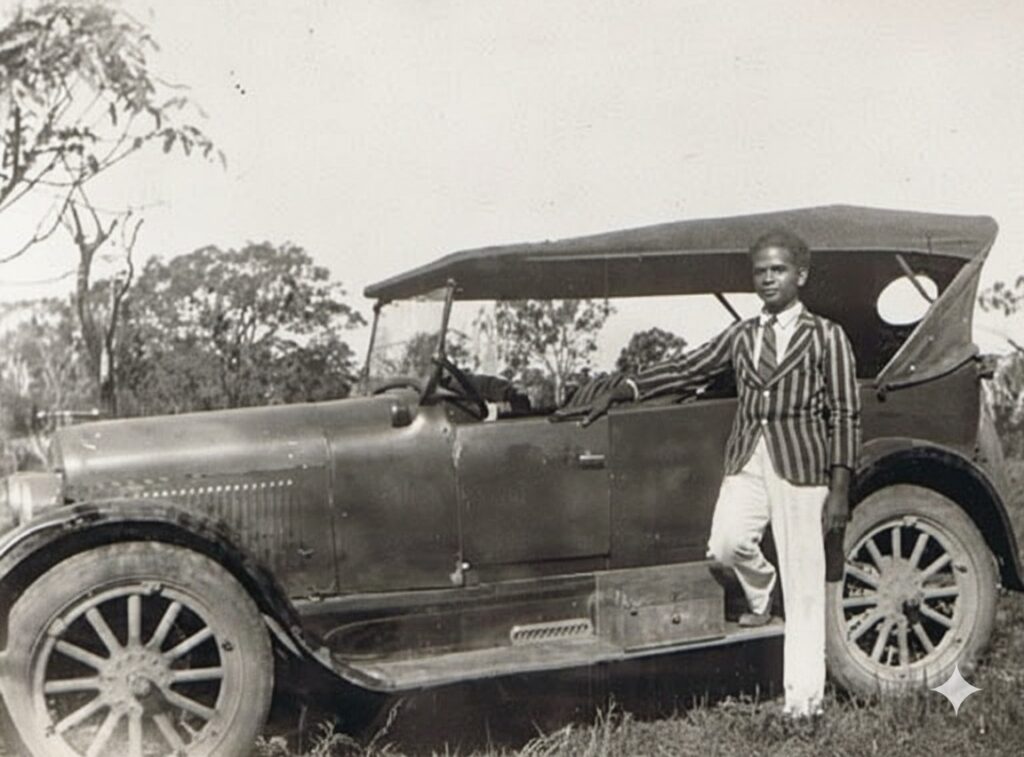
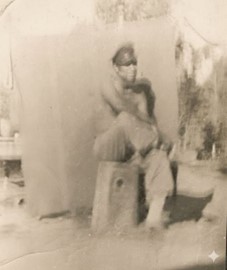
| Contemporary newspaper reporting preserved in Trove confirms Aboriginal residence at Wacol during the early 1950s. In October 1953, the Courier-Mail reported on Mr Cyril Richards, identified as living at the Wacol housing camp, who spoke publicly about the difficulties faced by Aboriginal people attempting to enter urban employment and civic life. His experience illustrates the challenges faced by Aboriginal residents navigating post-war Brisbane under assimilation-era policies. The public advocacy of Cyril Richards was unusual for its time. Richards, who lived at the Wacol housing camp in the early 1950s, was the great uncle of Aboriginal author Chrissy Doherty-Hansen. Family recollections indicate that he frequently spoke out on behalf of Aboriginal people and other disadvantaged residents because he carried significant caring responsibilities, including the care of a wheelchair-bound relative. This sense of responsibility appears to have shaped his willingness to engage publicly, despite the risks. At a time when many Aboriginal people avoided attention as a means of survival under restrictive policies and widespread discrimination, Richards’ stance was exceptional. His appearance in the Brisbane press was not simply an act of protest, but part of a broader effort to improve conditions for his family and community. Seen in this light, Richards’ advocacy helps explain why Wacol emerges in contemporary reporting not only as a place of residence, but also as a site where Aboriginal people attempted to negotiate visibility, rights and inclusion within post-war Brisbane. Cyril Richards was not the only member of his family living at Wacol. His younger brother, John Richards, also resided at the camp with his family. John Richards had served in the Australian Army during the Second World War, including overseas service in Papua New Guinea. His return to civilian life, and subsequent residence at Wacol, highlights a stark contradiction of the post-war period: Aboriginal men who had served their country were nevertheless excluded from mainstream housing and social systems. Family accounts record that John Richards found it distressing to witness his parents and relatives living in camp conditions after the war. His experience reflects the broader reality faced by many Aboriginal families in post-war Brisbane, where military service did not translate into social equality or secure housing. The presence of both Cyril and John Richards at Wacol underscores the camp’s role as a place where Aboriginal families negotiated the difficult transition from wartime contribution to post-war marginalisation. These details are drawn from the book of his great niece, Aboriginal author, Chrissy Hansen-Doherty—A Forgotten History, Moorooka Aboriginal Camp. |
Assimilation policies and Aboriginal life at Wacol
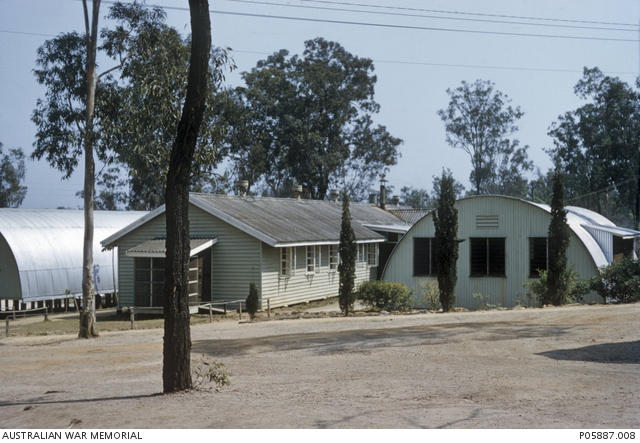
By mid-1954, Wacol had also become the focus of organised assimilation initiatives. A Brisbane Telegraph article described a “special project to assimilate aborigines, much the same as New Australians are assimilated”, operating directly at the Wacol housing camp. The project involved Aboriginal and non-Aboriginal children and parents, and the Housing Commission made a large hut available on a permanent basis for Aboriginal residents, to be used as a library and indoor recreation facility.
The language used in this reporting is revealing. Aboriginal integration at Wacol was explicitly framed in the same terms as migrant assimilation. This confirms that Wacol functioned as a shared post-war integration space rather than as separate facilities for different groups. It also explains why Aboriginal oral histories, including that of Aboriginal elder Aunty Theresa Williams, refer to living at the migration camp. The terminology may have shifted over time, but the place itself did not.
Aboriginal families at Wacol were living in former military huts originally intended to last only a few years. Conditions were often poor, and residents occupied a marginal position within post-war housing policy. Over time, as Wacol became more strongly identified as a migrant centre, Aboriginal presence faded from public memory, despite being clearly documented in contemporary sources.
This history adds an important post-war dimension to the Camp Columbia story. While Camp Columbia is rightly recognised for its wartime role as a major Allied staging area, its physical legacy continued to shape lives well into the 1950s. Wacol stands as a place where the social consequences of war were lived out on the ground, through housing scarcity, migration and the ongoing marginalisation of Aboriginal people.
Recognising Aboriginal lives at Wacol restores an essential part of the Camp Columbia landscape. It highlights continuity rather than rupture and ensures that Aboriginal experience is understood as integral to the post-war history of the site, not as an afterthought.