
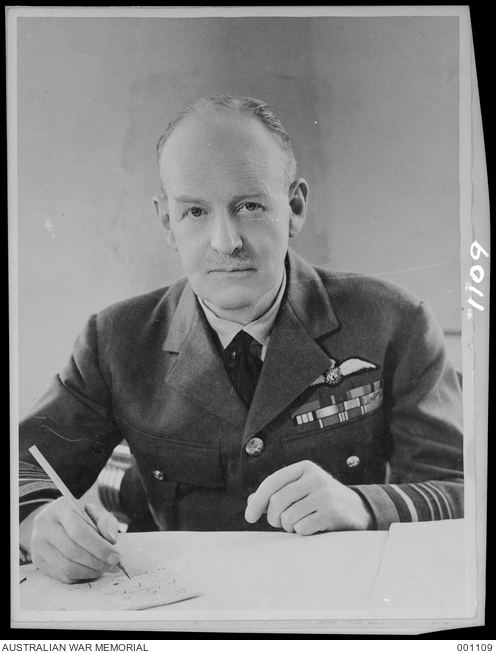
In the final months before the Pacific War reached Australia, the Netherlands East Indies emerged as a crucial source of intelligence on Japanese intentions. One of the senior Australian officers directly involved in receiving and assessing this information was Charles Burnett, Chief of the Air Staff of the Royal Australian Air Force.
Burnett’s role places him at the centre of Australia’s early engagement with Dutch intelligence and provides an important link between pre-war intelligence warnings and the later Dutch intelligence presence in Queensland, which culminated in the establishment of the Netherlands Forces Intelligence Service headquarters at Camp Columbia.
Burnett as Chief of the Air Staff
Charles Burnett, a senior officer of the Royal Air Force seconded to Australia, was appointed Chief of the Air Staff in 1940. At a time when Australia faced growing strategic uncertainty in the Asia–Pacific region, Burnett held responsibility for the operational readiness of the RAAF and for liaison with Allied air and intelligence authorities.
By late 1941, relations between Japan and the Western powers had deteriorated sharply. Australian defence planners increasingly relied on intelligence from regional partners, particularly the Netherlands East Indies, whose proximity to Japan’s southern advance made Dutch assessments especially valuable.
Dutch intelligence warnings and December 1941 discussions
In early December 1941, Burnett participated in high-level discussions in which information from Dutch intelligence sources was reviewed. These discussions involved senior Australian officers, the United States military attaché, and a Dutch liaison officer representing authorities in Batavia.
The Dutch intelligence information conveyed at this time included assessments of Japanese naval movements and the formal decision by the Netherlands East Indies authorities to activate their war plans. This step reflected the Dutch judgement that war was imminent and that existing defence arrangements with Australia should be put into effect.
Burnett’s involvement in these discussions positioned him as a key Australian figure in the transmission and evaluation of Dutch intelligence warnings in the days immediately preceding the outbreak of war in the Pacific.
From warning to wartime cooperation
Following the Japanese attack on Pearl Harbor and the rapid expansion of the Pacific War, Australia became a major base for Allied operations. Burnett continued to play a central role in coordinating air power and intelligence cooperation during this transition.
As the Netherlands East Indies fell to Japanese forces in early 1942, Dutch military and intelligence organisations were forced into exile. Australia, and increasingly Queensland, became the focal point for their reorganisation. The need for close cooperation between Australian authorities and Dutch intelligence services intensified.
Queensland and the growth of Allied intelligence structures
During 1942 and 1943, Queensland developed into a dense Allied intelligence environment. American, Australian and British intelligence organisations expanded rapidly, while Dutch intelligence activity was rebuilt in exile. Burnett’s position within the Australian defence establishment placed him within this evolving system of cooperation and coordination.
Although Burnett was not attached to Dutch intelligence organisations, his earlier engagement with Dutch intelligence warnings and his continuing senior role in Australian defence policy helped shape the environment in which Dutch intelligence operations could function effectively in Australia.
Camp Columbia and the consolidation of Dutch intelligence
In June 1944, Dutch intelligence activity in Australia was formally consolidated with the establishment of the Netherlands Forces Intelligence Service headquarters at Camp Columbia. Camp Columbia became the centre of Dutch intelligence, political and administrative activity in exile and operated in close coordination with Allied command structures in Queensland.
The Dutch intelligence presence at Camp Columbia did not emerge in isolation. It was the result of several years of growing cooperation, beginning with pre-war intelligence sharing and continuing through the early wartime period. Burnett’s role in receiving and engaging with Dutch intelligence in 1941 forms part of this longer trajectory.
Significance for Camp Columbia
Air Chief Marshal Charles Burnett’s relevance to Camp Columbia lies in his position at the Australian end of the intelligence relationship that preceded and enabled the Dutch intelligence presence in Queensland. His involvement in December 1941 discussions demonstrates that Dutch intelligence was taken seriously at the highest levels of Australian defence planning.
By the time Camp Columbia became the headquarters of Dutch intelligence in exile, the foundations for cooperation with Australian authorities had already been laid. Burnett’s actions during the critical transition from peace to war helped establish the trust and institutional familiarity that later allowed Dutch intelligence organisations to operate from Queensland as part of the Allied war effort.
Seen in this context, Burnett represents a key Australian link in the chain that connects Dutch intelligence warnings before the war with the establishment of Camp Columbia as a major Allied intelligence centre during it.