
When Allied forces expanded rapidly across the Pacific following the Japanese attacks of December 1941, Australia was transformed almost overnight from a distant imperial outpost into a central rear-area base for a global war. The scale of the challenge was unprecedented. Large numbers of Allied troops, particularly from the United States, began arriving in Australia at speed, placing immense pressure on ports, railways, cities and administrative systems that had never been designed to support such a role.
To manage this transformation, Allied planners introduced a structured logistical framework known as the Base Sections system. This system divided Australia into large geographical support zones, each responsible for sustaining military operations through supply, transport, medical care, training and administration. Camp Columbia and the wider Brisbane region became a key part of this system.
Origins of the Base Sections system
The Base Sections system was not devised in Australia before the war. It emerged in late 1941 and early 1942 as an emergency response to the sudden relocation of Allied military power into the Southwest Pacific. The framework was based on established U.S. Army logistical doctrine developed after the First World War and refined during the inter-war years, particularly within the U.S. Army Services of Supply.
Similar systems were already being applied elsewhere in the world. In Europe, the United Kingdom functioned as a vast base area supporting Allied operations prior to the Normandy landings, while large logistical commands operated across North Africa, the Middle East and later continental Europe. In Asia, base commands were established in India and Ceylon to support multinational forces operating across the China–Burma–India theatre.
Australia represented a new application of this global system. Unlike Britain or India, it had not been planned as a primary Allied base before the war. The Base Sections were therefore created rapidly, under crisis conditions, and adapted to Australia’s geography, infrastructure and political realities, in close cooperation with Australian military and civilian authorities.
How the Base Sections functioned
Each Base Section operated as a semi-autonomous logistical command rather than a combat formation. Its role was to sustain operations elsewhere by providing the essential rear-area services without which forward combat could not be conducted.
Responsibilities typically included:
- receiving and accommodating arriving troops
- storing and distributing equipment, fuel and supplies
- operating hospitals and managing medical evacuation chains
- controlling transport through ports, railways and roads
- running training, replacement and specialist instruction facilities
- constructing and maintaining camps, depots, airfields and workshops
This structure allowed combat forces to concentrate on fighting while Base Sections ensured continuity, supply and recovery.
The seven Base Sections in Australia
As Allied forces continued to grow, Australia was subdivided into seven Base Sections, each aligned with a major city and transport hub:
- Base Section 1 covered the Northern Territory, with headquarters in Darwin, supporting northern defence and air operations.
- Base Section 2 covered northern Queensland, headquartered in Townsville, acting as a forward logistical link to New Guinea.
- Base Section 3 was headquartered in Brisbane and became one of the most important Base Sections, supporting major Allied command headquarters and extensive medical, training and supply networks.
- Base Section 4, based in Melbourne, supported southern industrial production, training and administration.
- Base Section 5, headquartered in Adelaide, focused on logistics, manufacturing and support functions.
- Base Section 6, based in Perth, supported Indian Ocean and western maritime operations.
- Base Section 7, headquartered in Sydney, played a major role in naval administration, training and supply.
Together, these Base Sections formed an integrated continental support system linking Australia directly into the global Allied war effort.
Base Section 3 and the scale of Allied Brisbane
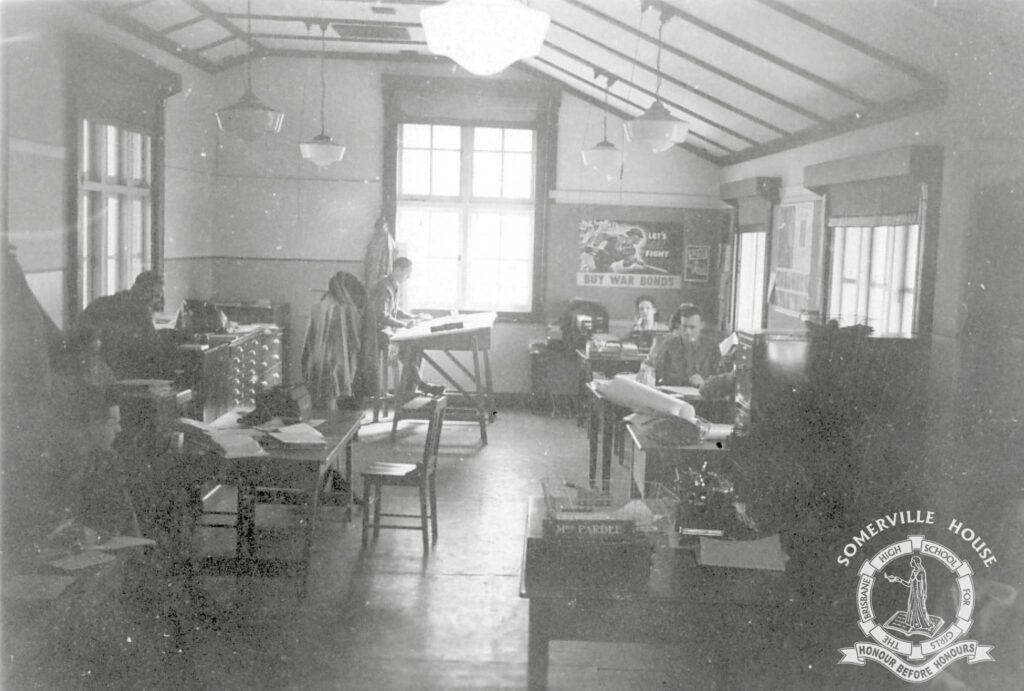
Base Section 3 occupied a particularly important position within this system. Brisbane combined deep-water port facilities, rail connections to southern Australia, proximity to New Guinea and large areas suitable for camps, depots and training establishments. As a result, the Brisbane region developed into one of the most heavily militarised areas in Australia during the war.
Over time, more than a dozen major camps and a wide range of supporting facilities were established across the region. These included permanent and semi-permanent hospitals, officer and specialist training schools, signals and logistics depots, supply warehouses, airfields and naval offices. Early field hospitals were progressively supplemented by fully established medical complexes, creating a network capable of treating thousands of Allied casualties evacuated from New Guinea, the Netherlands East Indies and other theatres. The US Seventh Fleet was born in Brisbane.
Camp Columbia, located west of Brisbane, functioned within this dense infrastructure as a command and coordination site. It was supported by, and connected to, a much wider system of hospitals, training establishments, transport hubs and depots spread across Base Section 3.
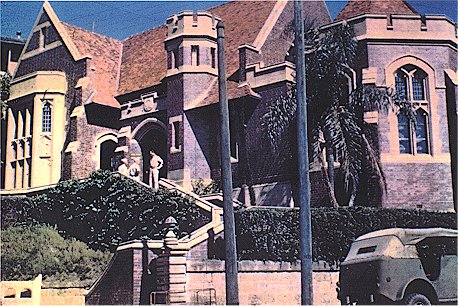
The headquarters of U.S. Army Base Section No. 3 was established in early 1942 at Somerville House in South Brisbane. Requisitioned by the United States Army soon after American forces began arriving in Australia, the school buildings were adapted for military use. By March 1942, Somerville House was functioning as the administrative centre for Base Section 3 under the United States Army Services of Supply. Contemporary records identify the former school library as one of the buildings used for headquarters offices, illustrating how existing civilian infrastructure was rapidly repurposed to meet Allied logistical needs during the crisis period of the Pacific War.
A multinational Allied base
Although American forces were numerically dominant, the Base Section system supported a genuinely multinational Allied presence. Australian military and civilian authorities provided the administrative, construction and transport backbone. Dutch military personnel, merchant seamen and later the Netherlands East Indies government-in-exile operated within the same logistical framework following the collapse of Dutch authority in Southeast Asia. From 1945 onwards, British naval forces also operated through Brisbane as part of post-war transition and redeployment.
Maritime activity was central to this system. Brisbane’s wharves handled a continuous flow of Allied merchant and naval vessels, forming part of a vast logistics network that sustained operations across the Southwest Pacific. Individual ships, such as the Dutch merchant vessel Bloemfontein, illustrate this activity, but they represent only a small part of a much broader Allied maritime effort involving American transport fleets, the Dutch Merchant Navy and later British naval units.
Camp Columbia in global perspective
Seen within the Base Sections framework and its global origins, Camp Columbia was neither isolated nor incidental. It was one node within a worldwide Allied logistics architecture that stretched from Britain and Europe to India, the Middle East and the Pacific.
Understanding this system explains why Camp Columbia mattered. Its significance lies not only in who was stationed there, but in how it fitted into a deliberately designed Allied structure that enabled Australia to function as a continental base for global war. In that sense, Camp Columbia belongs to the same historical category as major Allied base areas in Europe and Asia, adapted to Australian conditions and executed at extraordinary speed during a moment of crisis.
Sources:
This article draws on official U.S. Army histories of World War II logistics, including the United States Army in World War II series and wartime records of the United States Army Services of Supply, Southwest Pacific Area, which document the establishment and operation of Base Sections across Australia from 1942 onwards. Additional corroboration is provided by Australian War Memorial and National Archives records relating to U.S. Army Base Section 3 in Brisbane.