
This paper draws on the autobiography of Lt. Mark Twain Muller, a U.S. Army Signal Officer assigned to Base Section 3, to illuminate the operational and Allied significance of Camp Columbia, located west of Brisbane, during the critical early years of the Pacific War. Muller’s first-hand account provides rare insight into the establishment of Camp Columbia in early 1943 as the headquarters site of the U.S. Sixth Army under General Walter Krueger, including the rapid installation of communications infrastructure essential to Allied command and coordination in the Southwest Pacific.
Beyond its role as an American command centre, Muller’s narrative reveals Camp Columbia as a distinctly Allied environment. Australian authorities and civilian contractors supported the construction of depots, hospitals and communications facilities, while Australian communities provided logistical and social support to U.S. forces. The nearby 152nd Field Hospital, operating under canvas conditions, treated casualties not only from New Guinea but also from earlier campaigns in the Netherlands East Indies, including personnel evacuated from Java. Within this broader Allied context, Muller also refers to the Dutch merchant ship Bloemfontein, which had arrived in Brisbane as part of the Pensacola Convoy in late 1941 carrying U.S. military personnel, aircraft and equipment, before later transporting reinforcements to Java. The presence of the Bloemfontein highlights the disrupted yet continuing Dutch maritime contribution to the Allied war effort and Australia’s role as a refuge and logistical hub for Allied forces in exile.
Through Muller’s observations, Camp Columbia emerges as more than a temporary encampment or national headquarters. It appears as a shared Allied space where American command, Australian support structures and Dutch military and maritime displacement intersected. The paper therefore positions Camp Columbia as a key node in Allied cooperation in the Pacific War, linking strategy, logistics, medical care and human experience at a formative moment in the conflict.
With thanks to Peter Dunn.
Personal background of Lt. Mark Twain Muller
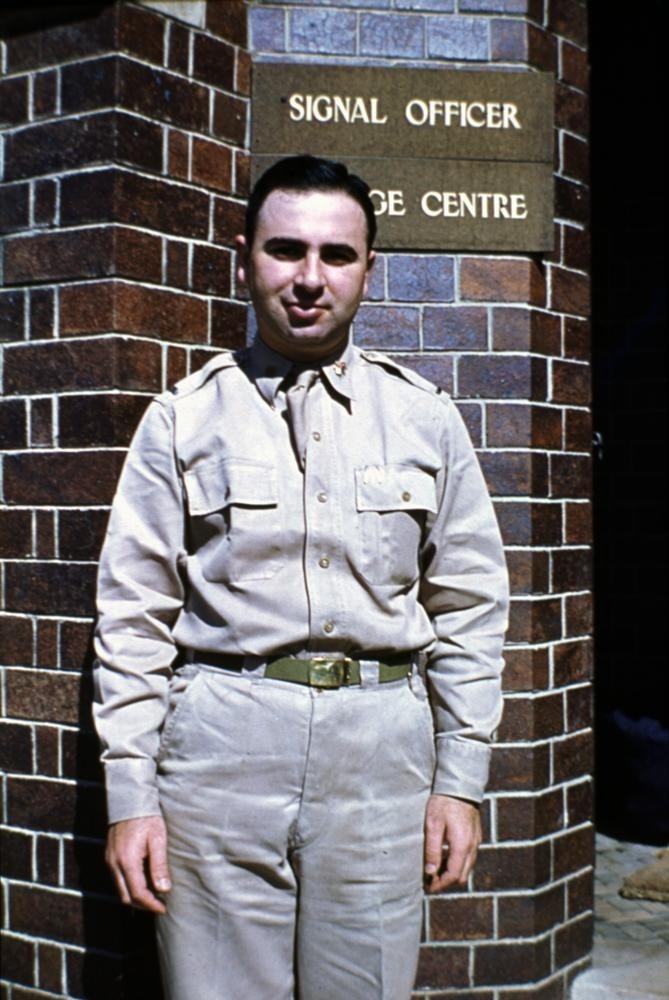
Lt. Mark Twain Muller’s account of Camp Columbia gains additional depth when placed within the context of his wider life and service. His observations reflect the perspective of a professional officer whose wartime responsibilities combined technical expertise with close engagement at senior command level.
Mark Twain Muller was born in New York City in 1915 and graduated from Cornell University in 1939. He was commissioned into the U.S. Army Signal Corps and, during World War II, served in the Southwest Pacific Area as a Signal Officer with Base Section 3. This role placed him at the centre of communications planning, installation and inspection, including responsibility for establishing signal infrastructure supporting the U.S. Sixth Army headquarters at Camp Columbia.
Signal Corps personnel at Camp Columbia formed part of the communications units attached to Headquarters, U.S. Sixth Army, responsible for maintaining secure links between Brisbane, General Headquarters SWPA, and forward operational commands across the Pacific.
Muller’s wartime service extended beyond Australia. He later served in the Korean War and held senior appointments during the Cold War period. Over the course of his career he rose to the rank of colonel before retiring from the U.S. Army. Following military service, he pursued a civilian career in engineering and academia, drawing on the technical and organisational skills developed during his Signal Corps years. Mark Twain Muller died in 2010.
Lieutenant Helen Kathryn Hoffman and a wartime connection
Among the individuals Muller encountered at Camp Columbia was Lieutenant Helen Kathryn Hoffman of the U.S. Army Nurse Corps. Hoffman was originally from Pittsburg, Texas, and served with the 152nd Field Hospital, a tent-based medical unit operating near Sixth Army headquarters under austere field conditions.
Muller’s autobiography records his concern about the hospital’s isolation and its limited communications. After discussions with hospital staff, including the unit commander and senior nursing personnel, he encouraged steps to improve signal links with headquarters and suggested direct engagement with Sixth Army command to address operational difficulties.
At the time, Muller did not know that one of the nurses serving with the unit, Lieutenant Hoffman, would later become his wife. He later reflected on the contrast between their backgrounds and personalities, noting that their relationship developed gradually within the shared environment of wartime Brisbane. Improved communications and access to transport made it easier for hospital staff to travel into the city, where Muller himself was stationed, allowing professional contact to develop into a personal connection.
Helen Kathryn Hoffman continued her service with the Army Nurse Corps, and the couple later married. She remained an important presence in Muller’s life until her death in 2004.