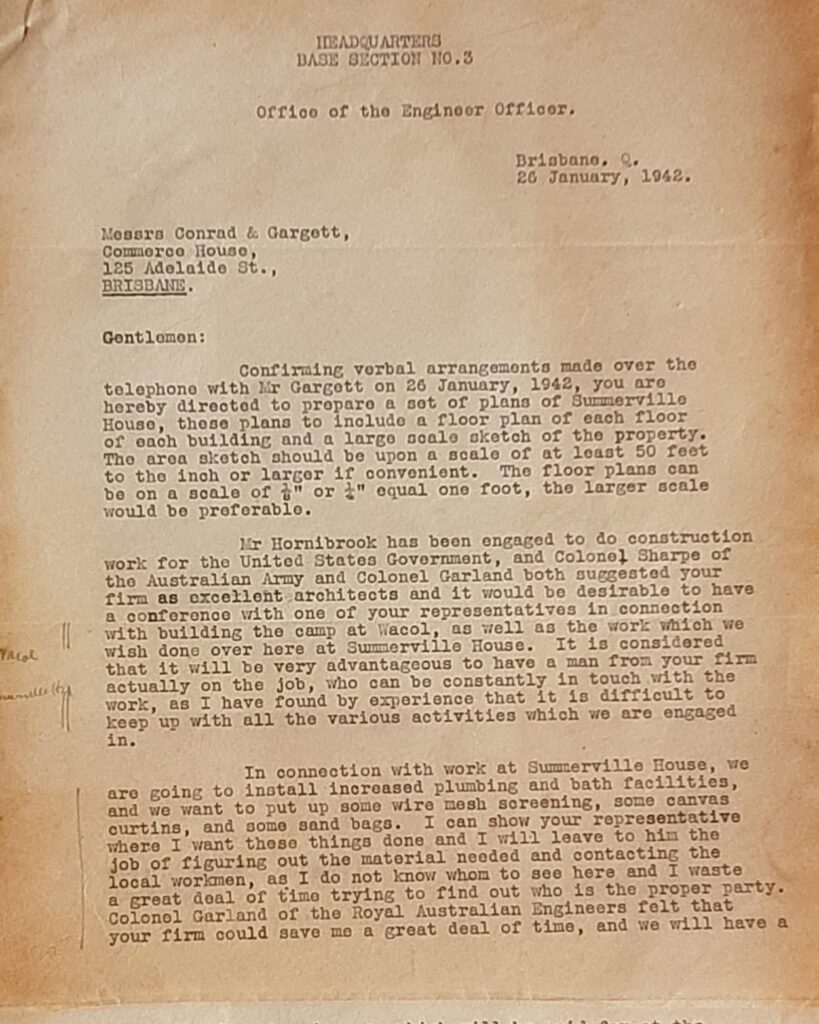
New archival evidence has come to light showing that preparations for a major United States military camp at Wacol were already underway in January 1942, earlier than previously documented. The discovery reinforces the view that the establishment of what later became Camp Columbia was planned from the outset as an American installation, with Australian authorities providing logistical and engineering support.
The document, identified by historian Peter Dunn, is a letter dated 26 January 1942 from the Office of the Engineer Officer, Base Section No. 3, Brisbane. Addressed to the architectural firm Conrad & Gargett, it instructs them to prepare detailed architectural and site plans of Summerville House and its surrounding grounds. These were to include floor plans of each building and a large-scale site sketch, clearly indicating that substantial construction and adaptation works were being planned.
Crucially, the letter states that construction work was being carried out for the United States Government and refers directly to “building the camp at Wacol.” Senior Australian officers, including Colonel Garland of the Royal Australian Engineers, are mentioned not as project owners but as facilitators who recommended the architects and assisted with coordination, local contractors, and materials.
The correspondence also shows that Summerville House was already being assessed for rapid wartime adaptation. Proposed works included increased plumbing and bathing facilities, wire mesh screening, canvas curtains, and other temporary measures typical of early American military installations. These details align closely with later documented American use of the site as part of a rapidly expanding headquarters and support complex.
As outlined on the Camp Columbia Heritage Park website, the Wacol site would soon develop into one of the largest United States military camps in Australia, serving as headquarters for the United States Sixth Army and playing a central role in Allied command, logistics, intelligence, and planning across the South West Pacific Area.
This newly surfaced document strengthens the historical record by confirming that American operational requirements shaped Camp Columbia from the very beginning, with Australian military engineers and government agencies acting swiftly to enable the U.S. presence. It also highlights the speed and depth of Allied cooperation in Brisbane during the critical weeks following the outbreak of war in the Pacific.