
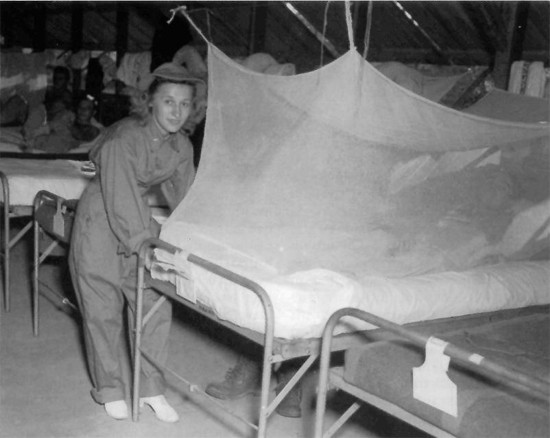
The presence of the 152nd Field Hospital at Camp Columbia highlights an essential but often understated dimension of the site’s wartime role. Alongside command headquarters and signal units, Camp Columbia was also a place of medical care, recovery and endurance during a formative phase of the Pacific War.
The 152nd Field Hospital formed part of the U.S. Army Medical Department’s expanding wartime medical system, designed to support rapidly moving forces operating far from established infrastructure.
During World War II, the U.S. Army reorganised its medical services to meet the demands of global warfare. Field hospitals became a central element of this system. They were mobile, tent-based units designed to provide definitive medical and surgical care in locations where permanent facilities did not exist.
Field hospitals in the world war II U.S. Army
Typically organised into a headquarters and several hospitalisation units, field hospitals were flexible and capable of operating independently. They were especially important in theatres such as the Southwest Pacific, where terrain, distance and limited infrastructure complicated evacuation to rear-area hospitals.
A field hospital at Camp Columbia
A rare first-hand account of the 152nd Field Hospital at Camp Columbia is provided byLt. Mark Muller, a Signal Officer with Base Section 3. His autobiography offers a detailed snapshot of conditions at the site in early 1943.
Muller noted that the hospital was located approximately a quarter of a mile from the headquarters of the U.S. Sixth Army. The unit consisted of around twenty nurses, ten doctors and a substantial number of enlisted medics. All were housed under canvas, including wards, a mess hall, a bivouac area and a single operating room.
The senior nurse, a Major from Maine, described the unit’s way of life as resembling the American western frontier of the 1890s. Drinking water was stored outdoors in suspended Lister bags and heavily chlorinated. Laundry was done by hand in wash basins. Nurses wore fatigue clothing identical to that of the doctors, reflecting the practical realities of field service rather than peacetime distinctions.
These details firmly place the 152nd Field Hospital within the broader field hospital tradition: improvised, mobile and dependent on adaptability.
Patients and early Pacific War experience
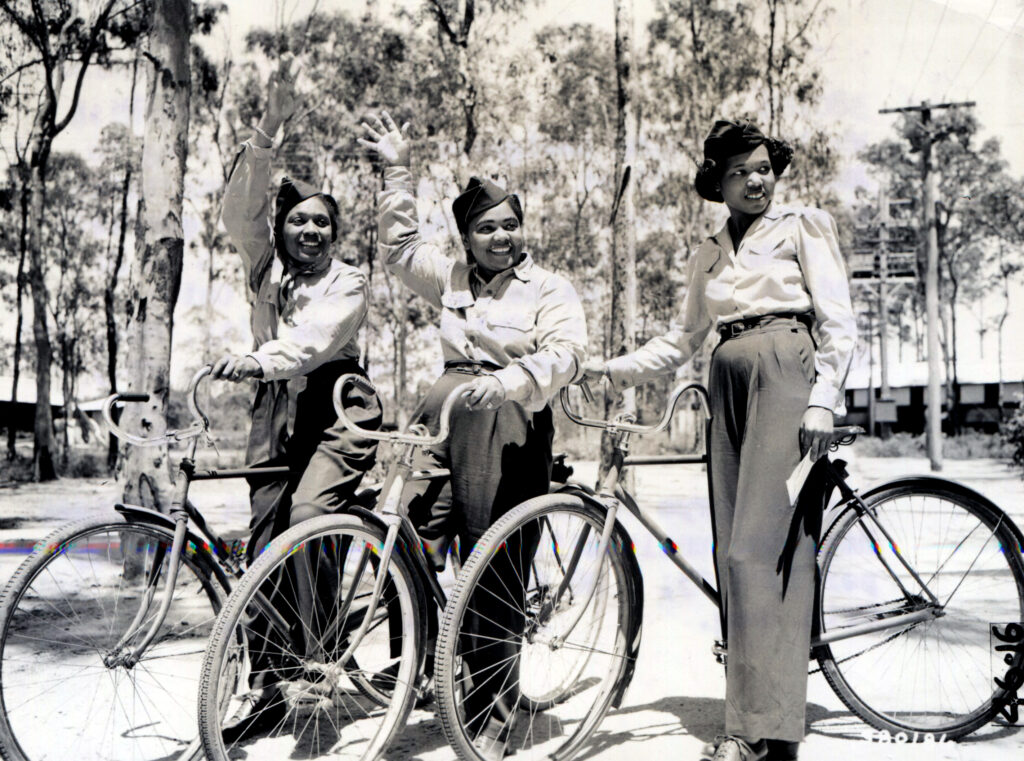
The hospital was actively treating patients during its time at Camp Columbia. Muller recorded that approximately fifty patients were present, many wounded in New Guinea. Others had escaped from the Philippines and Java, carrying injuries and illnesses from the chaotic early months of the Pacific War.
The 152nd Field Hospital therefore functioned as a critical stabilisation and recovery point within the Allied medical evacuation chain, linking front-line operations with longer-term care facilities elsewhere in Australia.
Communications and advocacy
Despite its importance, the hospital initially suffered from poor communications. Muller observed that it had only a single telephone line connected to a nearby Australian unit and struggled to reach higher headquarters.
After speaking with the hospital commander, a lieutenant colonel whose name Muller did not record, Muller suggested that the unit seek temporary connection to the Sixth Army switchboard to improve its operational effectiveness. He also encouraged the hospital’s Chief Nurse to approach General Walter Krueger directly for assistance.
The outcome was positive. Improved communications strengthened coordination and fostered closer interaction between medical staff and officers stationed nearby. Muller later reflected that proximity to Brisbane, combined with improved transport access, made life somewhat more bearable for staff working under difficult conditions.
This episode illustrates how Camp Columbia functioned as an integrated military environment, where command, signals and medical services were closely interconnected.
Lieutenant Helen Kathryn Hoffman and a personal connection
Among the nurses serving with the 152nd Field Hospital was Lieutenant Helen Kathryn Hoffman from Pittsburg, Texas. Muller did not know at the time that she would later become his wife.
He later reflected on the unlikely nature of their connection, noting the differences in background, manner and outlook between them. Yet Camp Columbia provided the setting in which their paths crossed. Muller also observed that his intervention in improving communications and transport indirectly made it easier for nurses from the hospital to travel into Brisbane, where he himself was stationed.
This personal story does not diminish the historical significance of the unit. Instead, it underscores that Camp Columbia was a lived environment, where professional duties and personal lives intersected under wartime conditions.
Redeployment to New Guinea
The 152nd Field Hospital remained at Camp Columbia for approximately six months. As Allied operations moved north, the unit was redeployed to the seven-mile airstrip outside Port Moresby in New Guinea, following the forward movement of the campaign.
This redeployment reflects the core purpose of field hospitals: to accompany advancing forces and provide medical support as operational focus shifted closer to the front.
Interpreting the 152nd Field Hospital today
The 152nd Field Hospital adds an essential human dimension to Camp Columbia’s history. It reminds us that the site was not only a place of strategic planning and command, but also a place of care, hardship and resilience.
While later published records do not always preserve clear numerical histories for every wartime medical unit, contemporary testimony confirms that the unit at Camp Columbia functioned fully within the U.S. Army field hospital model.
Why the 152nd Field Hospital matters to Camp Columbia
Including the 152nd Field Hospital in Camp Columbia’s interpretation ensures a fuller understanding of the site as a functioning wartime landscape. Alongside generals, headquarters staff and planners were doctors, nurses and medics working under canvas, treating the wounded and sustaining the human capacity of the Allied war effort.
Their story reinforces Camp Columbia’s role as a place where military command, medical care and everyday human experience were inseparable.
Sources and further reading
Lt. Mark Muller, autobiography, Signal Officer Base Section 3
U.S. Army Medical Department histories on field hospitals in World War II
Camp Columbia Heritage Association site histories and timelines