
Among the many American military units stationed in wartime Brisbane, the 99th Signal Battalion remains one of the least documented. Yet fragmentary records and newly identified evidence now provide a clearer picture of its role within Brisbane’s wartime military network.
Signal Corps units generally worked behind the scenes, maintaining communications systems, logistics coordination and command links rather than appearing prominently in combat histories. Nevertheless, surviving evidence indicates that the 99th Signal Battalion formed part of the extensive communications infrastructure that supported Allied operations throughout the South West Pacific Area (SWPA).
While much of the battalion quickly moved north into operational areas, evidence suggests that one component remained in Brisbane for an extended period attached to Headquarters Sixth Army at Camp Columbia.
The long haul to Australia
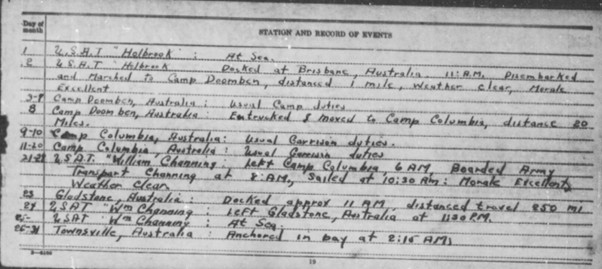
At 0800 on 14 April 1943, the 99th Signal Battalion departed San Francisco aboard the troop transport USAT Willard A. Holbrook. Like many American units heading into the Pacific, most of the men had little idea where they were going. Weeks at sea eventually gave way to the first indication of their destination when Australian information pamphlets were distributed onboard.
On 2 May 1943 the battalion arrived in Brisbane and moved to Camp Doomben. The battalion history later recalled Brisbane as merely the beginning of a much longer journey. Most personnel remained only briefly before moving north into operational areas. Significantly however, the battalion history recorded that a detachment remained behind for nine months.
At the time the identity of that detachment was not explained.
Brisbane as a communications hub
When General Douglas MacArthur established his SWPA headquarters in Brisbane in July 1942, the city rapidly became one of the most important Allied command and communications centres in the Pacific.
Military operations across the vast Pacific theatre depended on secure and reliable communications systems linking headquarters, troop movements, shipping, air operations, medical services and logistics networks. The US Army Signal Corps became central to this effort.
Large transmitting and receiving stations were established around Brisbane, including facilities at Hemmant, Rocklea and Redlands Bay. These installations handled military communications between Brisbane headquarters and Allied forces operating across New Guinea, the Philippines and other Pacific battle zones.
One of the key international communication links connected Brisbane directly to San Francisco, where communications then continued via landline to Washington DC. Brisbane therefore formed an important node within the wider Allied communications network.
Within this system, communications were not simply a support service. They formed the nervous system of Allied command across the Pacific.
Camp Columbia and Headquarters Sixth Army
Camp Columbia at Wacol formed an important part of this communications and logistics structure. The camp housed Headquarters US Sixth Army as well as major administrative, medical and support functions.
Until recently, evidence linking the 99th Signal Battalion directly to Camp Columbia remained uncertain. The battalion’s own history simply noted that while most personnel stayed in Brisbane only briefly, a detachment remained behind for nine months.
Additional Brisbane records now appear to identify this group. The October 1943 Military Telephone Directory for Brisbane lists Company “B” of the 99th Signal Battalion as a miscellaneous unit located in Area “A” attached to Headquarters Sixth Army at Camp Columbia.
This strongly suggests that Company “B” constituted the long-term detachment that remained in Brisbane while the remainder of the battalion moved north into active operational areas.
Its attachment to Headquarters Sixth Army is particularly significant. Signal units attached to headquarters formations maintained message centres, radio links, telephone exchanges and communications systems essential for command and control operations.
While surviving records do not yet identify the exact tasks undertaken by Company “B”, its presence at Headquarters Sixth Army strongly indicates involvement in the communications infrastructure supporting General Walter Krueger’s command organisation.
From Brisbane to the front line
Within weeks of leaving Brisbane, advance elements of the battalion moved into New Guinea. Lieutenant F. J. Mueller and a small detachment departed separately to establish a Sixth Army liaison radio station and message centre connected with General MacArthur’s headquarters.
The battalion subsequently followed Sixth Army operations across New Guinea and beyond, constructing communications systems under difficult combat conditions. Personnel laid miles of telephone wire through jungle terrain, established radio stations, built message centres and maintained communications links in newly captured operational areas.
The battalion participated in operations associated with Milne Bay, Goodenough Island, Kiriwina, Woodlark Island, Arawe, Cape Gloucester, the Admiralty Islands, Aitape, Hollandia and later campaigns further north.
Its wartime history described these activities as part of the “long road” that eventually led toward Manila and ultimately Tokyo.
Brisbane’s overlooked communications war
The story of the 99th Signal Battalion highlights an often-overlooked aspect of Brisbane’s wartime history.
Public memory has understandably focused on combat units, military hospitals and senior commanders. Less visible were the communication networks that enabled Allied operations to function across enormous distances.
Without Signal Corps personnel maintaining radio systems, message centres and telephone exchanges, the command systems linking Brisbane with New Guinea and the wider Pacific campaign could not have operated effectively.
The emerging evidence surrounding the 99th Signal Battalion suggests that Brisbane’s wartime role extended far beyond headquarters offices and troop camps. Hidden behind the scenes was a communications war that connected Camp Columbia and Brisbane directly to the battlefronts of the Pacific.
For Camp Columbia, Company “B” of the 99th Signal Battalion may represent another missing piece in understanding how this vast military complex functioned as one of the Allied command centres in the South West Pacific.
As per below, sources include: Overseas with the 99th Signal Battalion wartime history booklet an the Brisbane Military Telephone Directory (October 1943).
See also: 99th Signal Battalion, US Army in Australia during WWII