
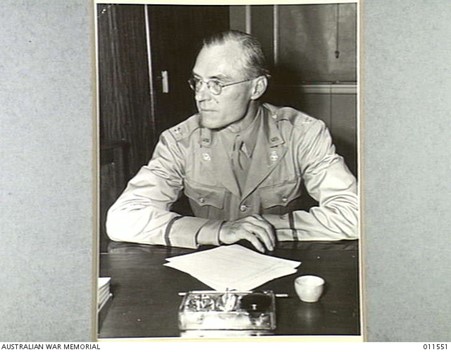
When General Headquarters, Southwest Pacific Area (GHQ SWPA) relocated to Brisbane in mid-1942, the city rapidly became one of the most important Allied command and intelligence centres of the Pacific War. Among the senior American officers working inside this new headquarters structure was Van Santvoord Merle-Smith, a figure who bridged diplomacy, intelligence and operational coordination at a critical moment in the war.
Merle-Smith – as he was known – is best remembered today for his role as United States military attaché in Australia on the eve of Pearl Harbor. For the history of Camp Columbia, however, his most relevant contribution lies in what followed: his work in Brisbane as part of the intelligence machinery that underpinned Allied operations in the Southwest Pacific and later intersected with Dutch intelligence activity centred at Wacol.
From military attaché to wartime headquarters officer
Merle-Smith arrived in Australia in September 1941 as the United States military attaché, initially based in Canberra and Melbourne. His role placed him at the intersection of American, Australian and Dutch military planning at a time when war was increasingly likely. In early December 1941, he participated in discussions with senior Australian officers and a Dutch liaison representative in which information originating from Dutch intelligence in the Netherlands East Indies was reviewed. This included Dutch assessments of Japanese naval movements and the formal decision by NEI authorities to activate their war plans, a warning that was subsequently conveyed through Allied channels.
After the outbreak of war and the rapid expansion of Allied command structures, Merle-Smith’s responsibilities shifted from diplomatic liaison to full-time staff work. When General Headquarters, Southwest Pacific Area was established under Douglas MacArthur, Merle-Smith became part of the intelligence staff, working within the G-2 section.
Brisbane and GHQ SWPA
In July 1942, MacArthur transferred GHQ SWPA from Melbourne to Brisbane. The intelligence staff moved with him, taking up offices in the AMP Building in the city centre. Merle-Smith was among those based there, serving as a senior intelligence officer at a time when the Allied command was still being shaped under immense operational pressure.
Contemporary GHQ summaries describe him as carrying a workload far heavier than his small staff size would suggest. His work focused on intelligence coordination, assessment and liaison rather than field operations. Brisbane was not a front-line location, but decisions made there influenced campaigns stretching from New Guinea to the Philippines.
Merle-Smith’s proximity to MacArthur’s headquarters placed him at the heart of Allied strategic planning in the Southwest Pacific during 1942 and 1943, when the balance of the war was still uncertain.
The wider intelligence environment in Queensland
Brisbane in these years hosted a dense and evolving intelligence ecosystem. American, Australian and British intelligence units operated alongside each other, while Dutch intelligence activity in exile expanded rapidly following the fall of the Netherlands East Indies.
From June 1944, this Dutch effort was formally concentrated at Camp Columbia, which became the headquarters of the Netherlands Forces Intelligence Service, NEFIS. Camp Columbia functioned as the centre of Dutch intelligence, political and administrative activity in Australia, closely linked to Allied command structures in Brisbane.
Merle-Smith was not stationed at Camp Columbia, nor was he formally part of NEFIS. His connection to the site lies instead in function and context. As a senior GHQ SWPA intelligence officer based in Brisbane, he operated within the same Allied intelligence framework that linked American, Australian and Dutch intelligence operations. The intelligence reports, communications and assessments moving through Camp Columbia fed into the broader Allied system of which GHQ SWPA was the apex.
In this sense, Merle-Smith belongs to the same wartime intelligence landscape as Camp Columbia: a networked system rather than a single location, with Brisbane as its operational hub.
Workload, strain and final years
The demands placed on GHQ SWPA intelligence staff during the early years of the war were intense. Merle-Smith was known to be overworked, and by 1943 his health began to fail. He was eventually evacuated back to the United States, where he died in New York in November 1943 at the age of 54.
His death cut short the career of an officer who had served in two world wars and who, in the Pacific, had helped lay the foundations of Allied intelligence coordination at a time when structures were still improvised and fragile.
A Dutch–American background
Merle-Smith’s connection to Dutch history was not professional but personal. Through his mother’s Van Santvoord family line, he descended from early Dutch-American settlers in New York. While this heritage had no direct bearing on his military role, it adds an interesting historical footnote to his presence in Australia at a time when Dutch and American forces were drawn into close cooperation in the Pacific.
Significance for Camp Columbia
Van Santvoord Merle-Smith’s importance to the Camp Columbia story lies not in physical location but in institutional proximity. His work in Brisbane formed part of the Allied intelligence architecture within which Camp Columbia and NEFIS later operated. He represents the American side of the intelligence partnership that took shape in Queensland and that gave Camp Columbia its wider strategic meaning.
Seen in this light, Merle-Smith’s Brisbane service helps illuminate Camp Columbia’s role as more than a Dutch enclave. It was part of a shared Allied intelligence system, developed under pressure and sustained by cooperation between Australians, Americans and Dutch in exile.
See also: