
Dutch intelligence headquarters in Brisbane, 1944–1945
When the Netherlands Forces Intelligence Service (NEFIS) moved its headquarters from Melbourne to Camp Columbia at Wacol in 1944, the former American military camp became the principal centre of Dutch intelligence activity in Australia.
From Camp Columbia, NEFIS collected, analysed and distributed information about the Japanese-occupied Netherlands East Indies, prepared maps and intelligence reports, maintained liaison with Allied organisations and supported clandestine operations directed back into the archipelago.
NEFIS was only one part of the much larger Dutch and Netherlands Indies presence at Camp Columbia. The Netherlands Indies Government, NICA, KNIL headquarters and other military and administrative organisations were also concentrated there. This brought intelligence officers into close contact with the civil servants, military personnel and specialists who were preparing for the Allied return to the Netherlands East Indies.
Camp Columbia therefore became more than an accommodation or military base. For a crucial period in 1944–45 it housed the headquarters of a Dutch intelligence organisation operating in exile while the war was moving back towards the territory it had been created to understand.
This article focuses specifically on NEFIS at Camp Columbia. The wider history of NEFIS, its organisation, Allied intelligence relationships and clandestine operations is covered in the DACC Research Portal on Dutch and Indonesian intelligence and special operations from Australia.
NEFIS moves to Camp Columbia
NEFIS had initially operated from Melbourne, where Dutch military and government organisations regrouped after the Japanese conquest of the Netherlands East Indies in 1942.
As the Allied campaign moved north through New Guinea, Brisbane became increasingly important. General Douglas MacArthur’s Southwest Pacific Area headquarters was already based in the city, while Dutch military, intelligence and administrative organisations were also being moved closer to the operational theatre.
In June–July 1944, NEFIS transferred its headquarters from Melbourne to Camp Columbia.
The move involved personnel, files, maps, photographic material and other intelligence resources. Australian staff member Jean van Schilfgaarde later recalled that the NEFIS organisation travelled north by special train and established itself in new offices at Wacol.
Camp Columbia offered NEFIS something it had not previously enjoyed to the same extent in Australia: the ability to operate alongside the wider Netherlands Indies government and military organisation in one large complex.
That proximity was important. Intelligence concerning the occupied archipelago was not only military. NEFIS also needed geographical, economic, administrative and political information, all of which could draw on the expertise of people from across the pre-war Netherlands Indies government and military system.
What NEFIS did at Camp Columbia
From its headquarters at Camp Columbia, NEFIS collected, assessed and organised intelligence concerning the Japanese-occupied Netherlands East Indies.
Much of this work was less dramatic than the clandestine missions for which NEFIS later became known. Intelligence officers and civilian staff worked with reports, maps, photographs, interrogation records and information obtained from people who had recently been in Japanese-controlled territory.
Refugees, escaped prisoners, seamen and others reaching Allied territory could possess valuable information. They might know the location of Japanese troops, airfields, shipping facilities, fuel stores, roads or communications infrastructure. They could also provide information about conditions in particular towns, islands and communities.
Some of these people were interrogated at Camp Columbia itself.
One documented example is Oe Beng Kiang, a Malaysian-Chinese crewman rescued by an American submarine after his vessel was torpedoed. After being brought to Australia and eventually to Camp Columbia, he was questioned by NEFIS. The surviving intelligence report records information concerning Japanese logistics, facilities and manpower.
NEFIS also assembled and maintained extensive geographical intelligence.
Maps and other records were compiled for Java, the Moluccas, New Guinea and numerous smaller islands across the archipelago. Information about roads, harbours, beaches, airfields, settlements and terrain could be combined with intelligence about Japanese forces and installations.
Surviving NEFIS map folders now held by Museum Bronbeek provide tangible evidence of this work. They show how information gathered from many different sources was organised geographically so that it could be retrieved and used by intelligence officers and Allied planners. The surviving collection and its connection with Camp Columbia are examined in more detail here: Mapping the road home: NEFIS, Camp Columbia and the Allied intelligence war
Camp Columbia therefore functioned as an intelligence-processing centre as much as an operational headquarters.
Information arrived from the field and from people reaching Australia. It was assessed, organised and incorporated into reports, maps and other intelligence products. Relevant material could then be passed to Allied commands preparing operations in New Guinea and the Netherlands East Indies.
As the Allied advance moved progressively closer to the occupied archipelago, this accumulated knowledge became increasingly valuable.
Behind the secret missions and individual agents was a much larger headquarters organisation at Camp Columbia engaged in the continuous work of collecting, checking, organising and distributing information.
NEFIS personnel at Camp Columbia
NEFIS at Camp Columbia was an international organisation.
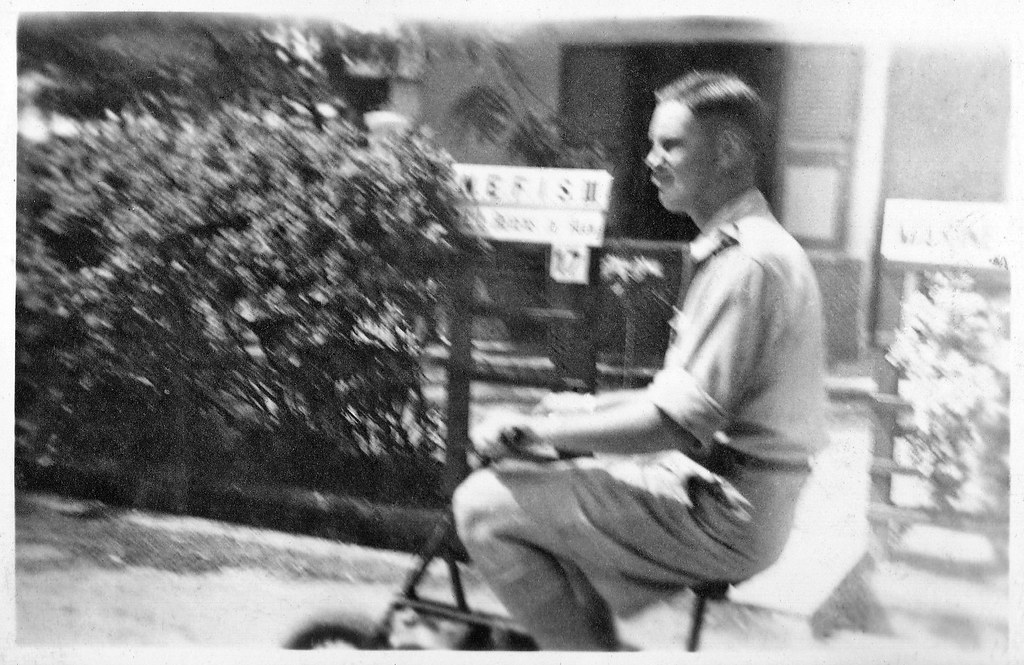
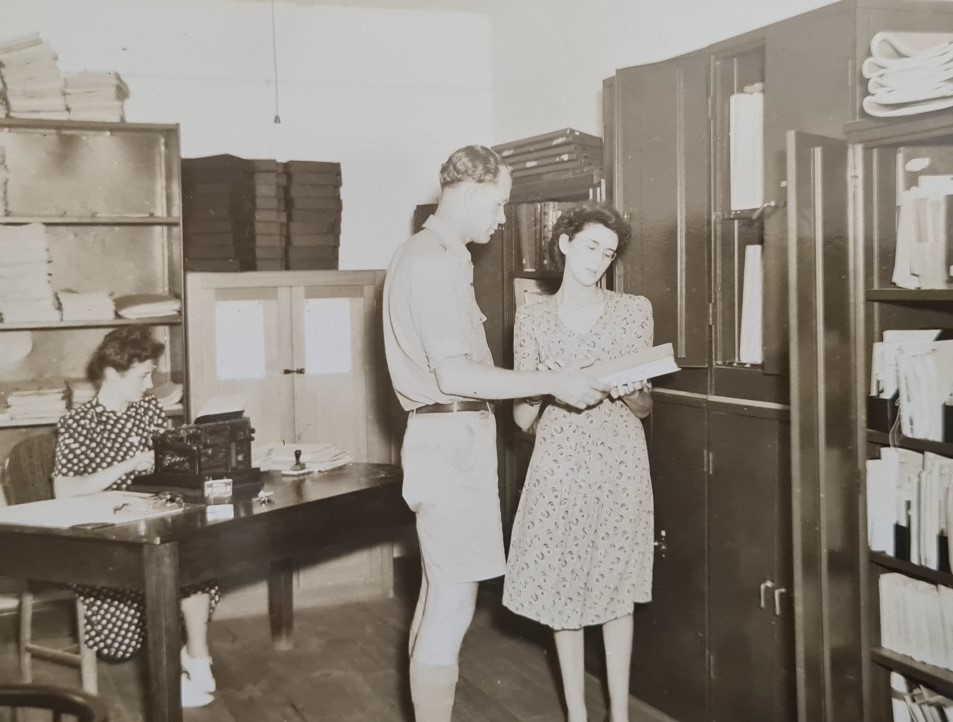
Its headquarters included Dutch military and naval officers, Netherlands East Indies personnel, Indonesian servicemen and civilian specialists, together with Australians recruited to assist with mapping, photography, administration and other intelligence work.
By 1944 NEFIS had grown into a substantial organisation. Simon Hendrik Spoor, who had played a leading role in developing Dutch military intelligence in Australia, became its director. Senior officers headed the different intelligence and operational sections, while a much larger body of military and civilian personnel carried out the day-to-day work of the service.
Australian civilians formed an important part of this headquarters organisation.
One of them was Jean van Schilfgaarde, who had joined NEFIS in Melbourne and moved with the organisation to Camp Columbia in July 1944. She worked in the Mapping Room, where staff drew and annotated maps and aerial photographs with information that could be useful for Allied operations against Japanese-occupied territory.
Her recollections provide a rare personal description of everyday life inside NEFIS at Camp Columbia.
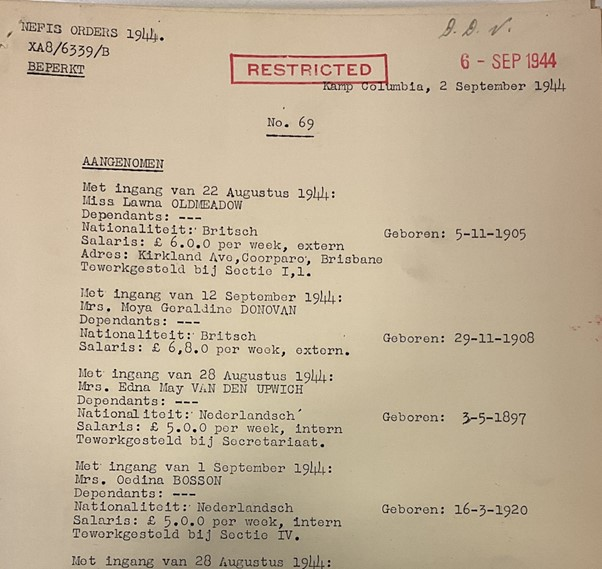
Jean recalled that Australians had been recruited into the organisation from its early period in Melbourne, including women employed as sketch artists as well as personnel seconded from Australian military services. At Camp Columbia they worked alongside people who had reached Australia from many different parts of the Netherlands East Indies and the wider wartime world. Her full recollections of working with NEFIS in Melbourne and at Camp Columbia can be read in: Personal recollections Camp Columbia – Jean van Schilfgaarde.
Indonesian personnel were also essential to NEFIS.
Their knowledge of local languages, communities, geography and conditions within the archipelago was particularly important for intelligence work and clandestine operations. Indonesian servicemen participated in some of the most dangerous missions undertaken by NEFIS, returning secretly to Japanese-occupied territory from bases in Australia and the forward operational area.
The surviving staff lists, photographs and personal recollections therefore reveal something that can easily be lost when NEFIS is described simply as a “Dutch intelligence service”.
At Camp Columbia it depended upon the combined knowledge and work of Dutch, Indonesian and Australian personnel.
The headquarters at Wacol brought these people together within a single intelligence organisation whose attention remained focused on territory thousands of kilometres to the north.
From Camp Columbia back into occupied territory
The intelligence work undertaken at Camp Columbia ultimately served an operational purpose: supporting the Allied advance and the return of Dutch and Indonesian personnel into the Japanese-occupied Netherlands East Indies.
NEFIS headquarters formed part of a much larger chain extending from Brisbane to forward bases in northern Australia, New Guinea and the eastern Netherlands East Indies. Information collected and analysed at Camp Columbia helped build the geographical and military knowledge needed for operations, while personnel selected for clandestine missions underwent specialised training and preparation elsewhere in Australia.
The Z Experimental Station near Cairns became particularly important for this work. Dutch and Indonesian operatives trained there in communications, weapons, fieldcraft and survival before deployment into enemy-held territory.
By late 1944 and 1945, NEFIS special-operations parties were being inserted into the occupied archipelago by aircraft, submarine, small vessels and local craft. Their tasks included gathering information about Japanese forces, establishing wireless communications, identifying landing areas and routes, making contact with local populations and preparing for the Allied advance.
Operations such as APPLE in Borneo and GOLDFISH towards Java illustrate the extraordinary distances separating the headquarters organisation at Camp Columbia from the agents operating in the field.
These missions also demonstrate the risks involved. Communications could fail, local cooperation could not be assumed, and agents captured by Japanese forces faced interrogation, torture and execution. Dutch and Indonesian personnel were among those who lost their lives.
Camp Columbia was therefore not itself the launching point for most clandestine insertions. Its importance lay in its role as the headquarters, intelligence-processing and coordination centre behind a network of forward bases, training establishments, communications stations and operational parties extending northwards from Australia into the occupied archipelago.
The wider history of these operations — including the NEI Section, NEFIS III, the Z Experimental Station, wireless networks, Party APPLE, GOLDFISH and the individual agents involved — is examined in detail in the DACC Research Portal on Dutch and Indonesian intelligence and special operations from Australia.
Cooperation with Allied intelligence in Brisbane
NEFIS did not operate at Camp Columbia in isolation.
Brisbane had become one of the principal Allied command and intelligence centres in the Southwest Pacific. General Douglas MacArthur’s General Headquarters was based in the city, together with Australian and Allied organisations responsible for intelligence, reconnaissance, codebreaking and special operations.
NEFIS maintained liaison with this wider Allied intelligence network. Its particular value lay in its specialised knowledge of the Netherlands East Indies: its geography, languages, population, administration and military situation.
Information gathered by NEFIS could therefore contribute to Allied planning, while Dutch and Indonesian personnel depended upon Allied organisations for aircraft, submarines, communications, training and other operational support.
The relationship was not always simple. The different organisations had their own command structures, responsibilities and priorities, and NEFIS remained a Netherlands organisation rather than a branch of Australian or American intelligence. Nevertheless, the concentration of these organisations in and around Brisbane made cooperation considerably easier.
Camp Columbia was therefore one component of a much larger intelligence network extending across Brisbane, northern Australia and the Southwest Pacific.
The broader relationships between NEFIS, Australian intelligence and special-operations organisations are examined in the separate article Intelligence Cooperation in the Southwest Pacific Area.
Preparing for the return
As Allied forces advanced through New Guinea and towards the Netherlands East Indies during 1944–45, the emphasis of NEFIS work increasingly shifted towards supporting the return to occupied territory.
Maps, aerial photographs, interrogation reports and information gathered by intelligence parties helped build a picture of Japanese positions, transport networks, airfields, harbours, settlements and local conditions.
This information was important not only for military operations. The Netherlands Indies authorities were also preparing to restore civil administration in territory recovered from Japan.
That brought NEFIS into increasing contact with the Netherlands Indies Civil Administration (NICA), which also established its headquarters at Camp Columbia.
The two organisations had different functions. NEFIS was primarily an intelligence organisation; NICA was responsible for preparing and restoring civil administration. In the fluid conditions of newly recovered territory, however, their work could overlap. Information about local officials, population movements, food supplies, communications and political conditions could have both intelligence and administrative value.
Camp Columbia’s importance lay partly in bringing these different functions together. Intelligence officers, military headquarters, civil administrators and government officials could work within the same Netherlands Indies complex while preparing for the return north.
The wider history of NICA, including its deployment into New Guinea, Morotai and Borneo, is covered separately in the DACC Research Portal.
The end of NEFIS at Camp Columbia
Japan’s surrender in August 1945 fundamentally changed the circumstances in which NEFIS operated.
The intelligence organisation had spent the previous three years gathering information about Japanese-occupied territory and supporting Allied operations directed towards its recovery. With the end of the Pacific War, that purpose rapidly changed.
At the same time, the centre of Dutch and Netherlands Indies activity began shifting away from Australia and back towards the archipelago.
Camp Columbia did not close immediately. Dutch military, administrative and intelligence personnel continued to operate there during the transition, while personnel and government functions were progressively transferred northwards.
The political environment they encountered was also very different from the one envisaged during wartime planning. Sukarno and Mohammad Hatta had proclaimed Indonesian independence on 17 August 1945, and the return of Dutch authorities increasingly became part of the developing struggle over Indonesia’s political future.
NEFIS consequently entered a new phase. Its postwar activities became increasingly concerned with political and security intelligence in the Netherlands East Indies rather than the Allied intelligence war against Japan.
This also marks the appropriate end of the Camp Columbia part of the NEFIS story.
The precise date on which the last NEFIS headquarters functions left Camp Columbia has not yet been established. What is clear is that the organisation’s centre of activity progressively shifted back towards the Netherlands East Indies as the wider Dutch and Netherlands Indies presence at Camp Columbia was wound down during 1945–46.
The subsequent history of NEFIS belongs principally to the history of the Indonesian Revolution and Dutch-Indonesian decolonisation rather than to the wartime history of Camp Columbia.
Camp Columbia’s intelligence legacy
For approximately a year, Camp Columbia was the headquarters of the principal Netherlands intelligence organisation concerned with the Japanese-occupied Netherlands East Indies.
Much of what happened there was necessarily invisible to the Australian public. Behind the fences and office buildings at Wacol, Dutch, Indonesian and Australian personnel analysed reports, interrogated sources, worked with maps and aerial photographs, maintained extensive records and supported operations extending thousands of kilometres north into enemy-held territory.
The surviving evidence is scattered across archives in Australia, the Netherlands and Indonesia. NEFIS reports and files, the map collection preserved at Museum Bronbeek, Australian War Memorial records, NIGIS photographs, staff records and the personal recollections of people such as Jean van Schilfgaarde are gradually allowing this history to be reconstructed.
Together they reveal another dimension of Camp Columbia.
It was not simply the wartime home of the Netherlands Indies Government and its military forces. For a crucial period during the final phase of the Pacific War, Camp Columbia was also one of the important Allied intelligence centres in Brisbane and the headquarters from which Dutch intelligence activity in Australia was coordinated.
Sources and further reading
I would then retain/update the existing sources, but make sure these core sources are included:
- Australian War Memorial, Allies in Adversity: Australia and the Dutch in the Pacific War — material concerning NEFIS, the Netherlands Indies Government and Camp Columbia.
- Nationaal Archief, The Hague — NEFIS and Netherlands Indies Government records relating to intelligence activities in Australia and the Southwest Pacific.
- Nederlands Instituut voor Militaire Historie (NIMH) — records and research concerning NEFIS, KNIL and Netherlands military activities in Australia.
- Museum Bronbeek — surviving NEFIS map folders and related material documenting geographical intelligence concerning the Netherlands East Indies.
- Arsip Nasional Republik Indonesia (ANRI), Inventaris Arsip Foto Netherlands Indies Government Information Service (NIGIS): Seri Wilayah Australia 1930–1946 — photographic inventory containing images of NEFIS personnel, offices and other Netherlands Indies organisations at Camp Columbia. ANRI NIGIS Australia photographic inventory
- Jack Ford, research on the Netherlands East Indies Government, NEFIS and Camp Columbia.
- Jean van Schilfgaarde, personal recollections of service with NEFIS in Melbourne and at Camp Columbia, recorded in correspondence with Jack Ford in 1992.
- Peter Dunn OAM, research concerning Allied intelligence and special operations in Australia and the Southwest Pacific.
Related Camp Columbia articles
Rather than reproduce their contents, I would finish with links to the specialist CC articles:
- Mapping the Road Home: NEFIS, Camp Columbia and the Allied Intelligence War
- Intelligence Cooperation in the Southwest Pacific Area
- Personal Recollections Camp Columbia – Jean van Schilfgaarde
- From Camp Columbia to Operation Kraai: The Australian Training of NEFIS Officer Jan Bakker
- Camp Columbia and the Training of Dutch Officers for the Netherlands Indies and New Guinea
- The Netherlands Indies Civil Administration (NICA) at Camp Columbia