
During discussions in the Netherlands in June 2026 between the Cultural Heritage Agency of the Netherlands (RCE), the University of Queensland and the Camp Columbia Heritage Association, it became clear that the history of Camp Columbia – also for the UQ students – is best understood within the broader context of the Second World War in the Pacific.
Camp Columbia is often viewed simply as a wartime site at Wacol in Brisbane. In reality, its significance extends far beyond Queensland. It provides a gateway to understanding Australia’s pivotal role in the Pacific War, the close wartime cooperation between Australia, the United States and the Netherlands, and the international developments that helped shape the post-war world.
One way of understanding Camp Columbia is through a series of expanding circles. Beginning with the camp itself, each successive circle reveals a wider historical context—from Brisbane as the Allied capital of Australia, to Australia’s role as the principal Allied base in the Southwest Pacific, to the campaigns fought across Southeast Asia and the Pacific, and finally to the global conflict that transformed the twentieth century.
Camp Columbia: the local story
At our centre lies Camp Columbia itself.
Established by the United States Army in 1942, Camp Columbia became one of the largest military installations in Australia. It served as a major staging and training area for American forces, including units of the US Sixth Army, which played a critical role in campaigns across New Guinea, the Philippines and the broader Pacific.
The camp also became home to the Netherlands East Indies Government-in-Exile. Lieutenant Governor-General Hubertus van Mook established key administrative functions there, while Dutch military and intelligence organisations operated from nearby facilities. The Netherlands Forces Intelligence Service (NEFIS) and the Netherlands Indies Civil Administration (NICA) both maintained important operations in Australia.
Camp Columbia therefore represented far more than a military base. It was a place where Australian, American and Dutch interests converged in the common struggle against Japan.
Brisbane: the Allied capital of Australia
The next circle extends beyond Wacol to Brisbane itself.
Few people realise that during much of the war Brisbane functioned as the Allied capital of Australia.
General Douglas MacArthur established the headquarters of the Southwest Pacific Area in Brisbane in 1942. From the MacArthur Chambers building in Queen Street he directed Allied operations stretching from New Guinea to the Philippines.
At the same time General Sir Thomas Blamey relocated the headquarters of the Australian Military Forces to Brisbane. The University of Queensland’s St Lucia campus was requisitioned for military purposes and became an important command centre for Australian operations.
At Camp Columbia and elsewhere in Brisbane, Hubertus van Mook coordinated the activities of the Netherlands East Indies administration in exile.
As a result, Brisbane became the only city in Australia where the headquarters of the American Southwest Pacific command, the Australian Army command and the Netherlands East Indies Government-in-Exile operated simultaneously.
In many respects Brisbane became one of the most important Allied command centres in the world.
Australia: the great base
The next circle encompasses Australia as a whole.
Following the fall of Singapore and the occupation of the Netherlands East Indies in early 1942, Australia became the principal Allied base in the Southwest Pacific.
An enormous military infrastructure was developed across the country.
Important facilities included:
• Archerfield and Eagle Farm in Brisbane.
• Amberley Air Base.
• US Navy submarine base New Farm
• Townsville, which became a major military logistics centre.
• Garbutt Air Base in North Queensland.
• Bundaberg and other Queensland airfields.
• Darwin and numerous Northern Territory air bases supporting operations in Timor and the Dutch East Indies.
• Cairns and Cooktown as staging points for New Guinea operations.
• Sydney and Melbourne as major administrative and naval headquarters.
• Fremantle, which became one of the world’s largest Allied submarine bases.
• Flying boat bases at Rose Bay, Rathmines, Cairns and elsewhere.
• Training camps and supply depots spread throughout the country.
More than a million American servicemen passed through Australia during the war. Vast quantities of equipment, fuel, food and ammunition were assembled and distributed from Australian ports and bases.
Without this infrastructure, Allied operations in the Southwest Pacific would have been impossible.
The Southwest Pacific campaign
The next circle moves north into Southeast Asia and the Pacific.
Many of the major campaigns against Japan were planned, supplied and supported from Australia.
These included:
• The Kokoda Campaign.
• The Battle of Milne Bay.
• The Buna-Gona Campaign.
• The campaigns in New Guinea.
• Operations in the Solomon Islands.
• The liberation of Dutch New Guinea.
• Operations in Borneo.
• The Philippines Campaign.
• Intelligence and special operations throughout the Netherlands East Indies.
• Support for resistance activities in occupied territories.
Australian, American and Dutch personnel often worked together in these operations. Dutch intelligence networks provided valuable information about Japanese activities in the Netherlands East Indies, while Australian and American forces supplied the military power needed to advance northward.
The Pacific War
Beyond these campaigns lies the wider Pacific War.
Japan’s expansion during the 1930s and early 1940s was driven by a combination of strategic, economic and ideological factors. Japanese leaders sought access to raw materials and aimed to establish what they called the “Greater East Asia Co-Prosperity Sphere”.
The attack on Pearl Harbor in December 1941 was intended to neutralise American naval power while Japan rapidly occupied resource-rich territories across Southeast Asia.
Within months Japan controlled vast areas including the Philippines, Malaya, Singapore, Burma and the Netherlands East Indies.
The occupation of the Dutch East Indies was particularly important because of its oil resources. Securing these resources was one of Japan’s principal strategic objectives.
Australia suddenly found itself on the front line of the conflict.
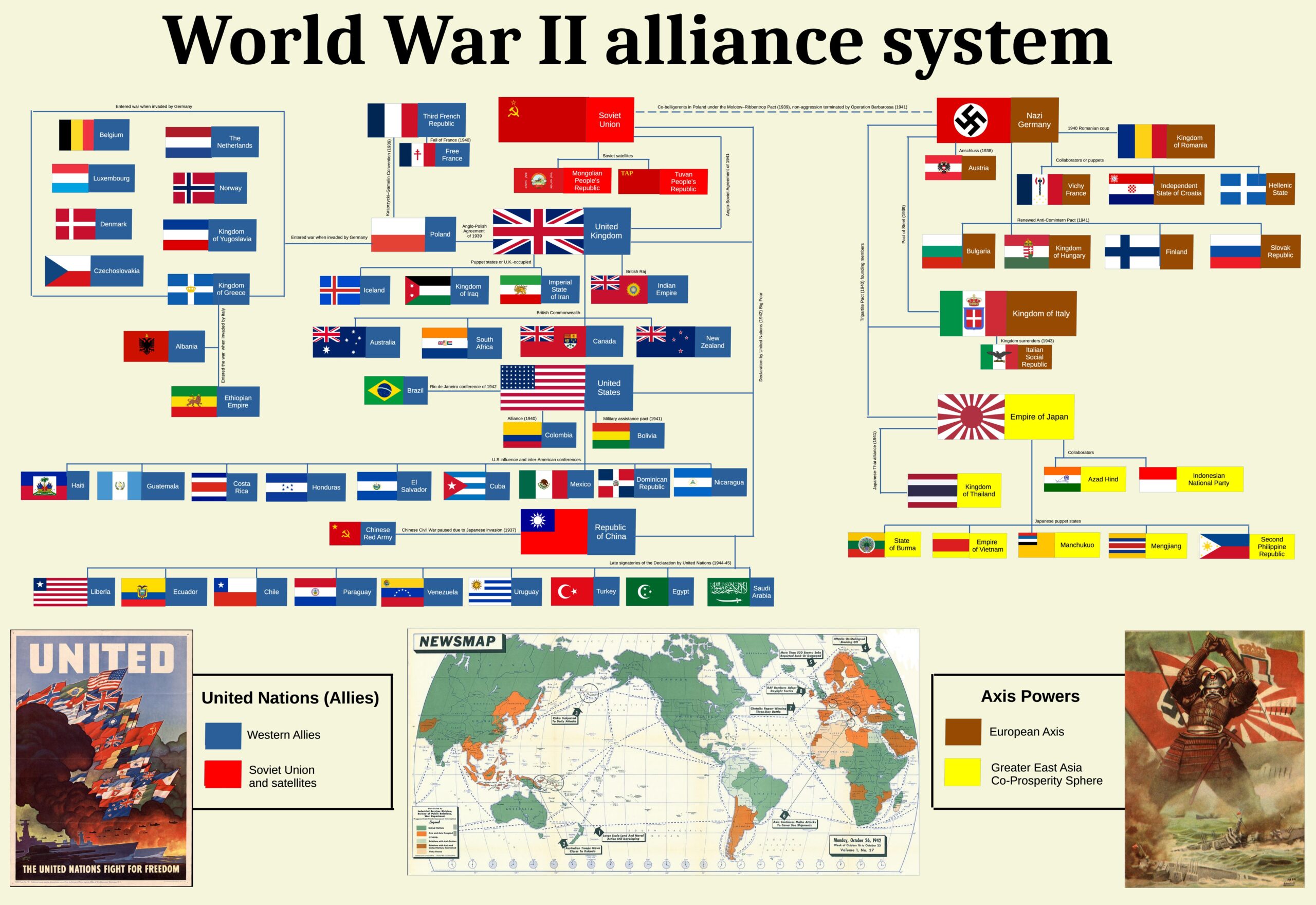
The global war
The next circle places the Pacific War within the broader context of the Second World War.
Although the war in Europe began in 1939, the conflict in Asia had already been underway for several years through Japan’s invasion of China.
After Pearl Harbor, the United States found itself fighting major wars in both Europe and the Pacific.
American strategy initially prioritised the defeat of Germany. This “Germany First” policy reflected the belief that Nazi Germany posed the greatest long-term threat.
Nevertheless, events in the Pacific demanded enormous resources. The Southwest Pacific campaign led by MacArthur became one of the largest military undertakings of the war.
By 1945 the Allied offensives launched from Australia had helped push Japanese forces back across the Pacific. The war ended with the surrender of Japan in September 1945.
The birth of modern Asia
The final circle looks beyond the military conflict itself to its lasting consequences.
The Allied victory did not restore the pre-war order in Asia. Instead, the Second World War accelerated the collapse of the European colonial empires and gave rise to the modern nations of Asia. India, Pakistan, Burma (Myanmar), Ceylon (Sri Lanka), the Philippines, Indonesia, Vietnam, Laos and Cambodia all emerged as independent states in the years following the war.
For Australia and the Netherlands these developments had profound consequences. Australia increasingly shifted its strategic focus from Britain towards the United States while developing closer relationships with its Asian neighbours. The Netherlands faced the loss of the Netherlands East Indies following the Indonesian War of Independence. Many of the Dutch organisations that had operated from Australia during the war—including the Netherlands East Indies Government-in-Exile, the Netherlands Forces Intelligence Service (NEFIS) and the Netherlands Indies Civil Administration (NICA)—were directly involved in this period of transition.
The political map of Asia that emerged after 1945 continues to shape the region today. The rise of China and India, Indonesia’s emergence as a regional power, tensions surrounding Taiwan and the continuing division of Korea all have their roots in the upheavals that followed the Second World War.
From this perspective, Camp Columbia tells more than the story of a military camp. It provides a unique Australian window into one of the greatest geopolitical transformations of the twentieth century—the birth of modern Asia.
See also: The Second World War and the birth of modern Asia
A story that reaches far beyond Brisbane
Understanding these expanding circles helps explain why Camp Columbia remains important today.
What appears at first glance to be a local military camp was in fact connected to decisions and events that shaped the course of the Pacific War, the outcome of the Second World War, and ultimately the birth of modern Asia.
From Camp Columbia we move to Brisbane. From Brisbane to Australia. From Australia to the Southwest Pacific. From the Pacific to the global conflict. And from the Second World War to the emergence of a new post-war Asia.
In that sense Camp Columbia is not merely a local heritage site. It is a place where local, national and international history intersect. It tells the story of how Australia became a central player in one of the defining conflicts of the twentieth century; how Australians, Americans and Dutch citizens worked together in the Allied war effort; and how that cooperation formed part of the wider transformation that reshaped Asia and the world after 1945.
The story of Camp Columbia is therefore much more than the history of a military camp. It is an Australian chapter in one of the greatest geopolitical transformations of the twentieth century.
Paul Budde
June 2026