
Introduction
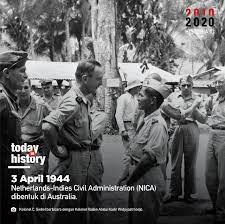
During 1944, Camp Columbia became an important centre for the Netherlands Indies Civil Administration (NICA), the organisation created to restore civil government in territories recovered from Japanese occupation.
NICA was not an intelligence service. Its principal responsibility was civil administration: preparing officials to enter recovered territory, restoring government services, assisting civilian populations and rebuilding the administrative structures disrupted by the Japanese occupation.
Camp Columbia became NICA’s headquarters and an important preparation and staging base. Here civil administrators, military personnel and specialists worked alongside the wider Netherlands Indies Government and organisations such as the Royal Netherlands East Indies Army (KNIL) and the Netherlands Forces Intelligence Service (NEFIS).
From Brisbane, NICA personnel were prepared and dispatched northwards as Allied forces recovered territory in New Guinea, the Moluccas and Borneo.
This article focuses specifically on NICA’s connection with Camp Columbia. The organisation’s wider history, its operations in recovered Netherlands Indies territory and the political consequences of the Indonesian declaration of independence are examined separately in the DACC Research Portal.
From Australia back to the Netherlands East Indies
NICA was formally established on 3 April 1944 as the Allied advance towards the Netherlands East Indies was gathering momentum.
The concept was straightforward. Allied military forces would recover territory from Japan, while NICA detachments would follow them and progressively assume responsibility for civilian administration.
This required personnel who could perform a wide range of tasks. Government offices had to be re-established, civilian populations registered and assisted, health and medical services restored, local officials identified, supplies distributed and damaged administrative systems rebuilt.
The first NICA detachments were already moving into the operational area before the organisation became firmly established at Camp Columbia. NICA personnel accompanied American forces into Hollandia in Netherlands New Guinea following the Allied landings in April 1944.
As the Netherlands Indies Government concentrated more of its military and administrative organisation in Brisbane during 1944, Camp Columbia became NICA’s principal Australian base.
This was particularly useful because NICA did not operate independently. Its work required close contact with the Netherlands Indies Government, KNIL, NEFIS and Allied military authorities.
Camp Columbia therefore became both a headquarters and a gateway. Personnel could be assembled, briefed and prepared there before moving north through the Allied transport system into recovered Netherlands Indies territory.
Training and preparing NICA personnel at Camp Columbia
One of Camp Columbia’s most important NICA functions was preparing personnel for service in territories being recovered from Japanese occupation.
The former American military facilities at the camp provided classrooms, accommodation and other infrastructure that could be used for this purpose. NICA personnel needed to understand not only civil administration but also the difficult conditions they were likely to encounter when deployed into recently liberated areas.
Training covered subjects relevant to the restoration of government, including civil law and justice, population administration, taxation, health and education. Personnel also needed knowledge of the regions to which they might be sent and the practical problems of working alongside Allied military forces.
This preparation reflected the unusual nature of NICA’s task. Its personnel were civil administrators, but they were entering areas in which military operations might still be continuing and where government services, communications and supplies had been severely disrupted.
Camp Columbia also brought NICA personnel into close proximity with the Netherlands Indies Government, KNIL, NEFIS and other organisations involved in planning the return. This allowed administrative preparation to be connected with military planning, intelligence and the practical arrangements for moving personnel and supplies northwards.
The separate article Camp Columbia and the Training of Dutch Officers for the Netherlands Indies and New Guinea examines this training program and its longer-term significance in more detail.
NICA headquarters at Camp Columbia
Camp Columbia became more than a training and staging centre for NICA. It also housed the headquarters from which the organisation prepared for the restoration of civil administration across the Netherlands East Indies.
This required extensive planning. NICA had to organise personnel for deployment, determine where particular specialists would be needed, arrange transport and supplies, and prepare for the immediate needs of civilian populations emerging from Japanese occupation.
The scale of the task was considerable. In many areas NICA could expect to encounter damaged infrastructure, disrupted government services, shortages of food and medicines, displaced populations and administrative records that had been lost or destroyed.
Much of this work depended upon cooperation with other organisations based at Camp Columbia. The Netherlands Indies Government provided the broader administrative framework, while KNIL headquarters dealt with military matters and NEFIS supplied intelligence about conditions in occupied and newly recovered territory.
NICA also depended heavily upon the Allies. Personnel and supplies had to be transported into operational areas controlled by American or Australian forces, while arrangements for civil relief required cooperation with Australian authorities and international relief organisations.
Camp Columbia’s location near Brisbane was particularly useful in this respect. General MacArthur’s Southwest Pacific Area headquarters and important Australian and Allied military organisations were based in or around the city, allowing the Netherlands Indies authorities to maintain liaison with the commands directing the advance northwards.
The result was an unusual concentration at Wacol of the people and organisations preparing for the return to the Netherlands East Indies.
From offices and training facilities at Camp Columbia, NICA attempted to turn plans prepared in exile into functioning administrative teams capable of following Allied forces back into the archipelago.
From Camp Columbia into the field
NICA’s work at Camp Columbia had a practical objective: getting administrative personnel back into the Netherlands East Indies.
The first NICA detachments had already accompanied American forces into Netherlands New Guinea in 1944. As the Allied advance continued, NICA personnel operated from forward bases such as Morotai and followed Australian forces into Borneo during the Tarakan and Balikpapan operations of 1945.
Their responsibilities varied according to local circumstances. They registered and assisted civilians, organised food and medical relief, restored administrative services, recruited local labour and gathered information about conditions in areas emerging from Japanese occupation.
The Australian campaigns in Borneo demonstrated particularly clearly how the system was intended to work. Australian troops secured territory while NICA personnel moved in behind them to deal with civilian administration and relief.
Camp Columbia formed the Australian end of this chain. Personnel could be assembled and prepared at Wacol before travelling north through the Allied military transport system into the operational area.
Individual stories help reveal how this worked in practice. Officials and military personnel passed through Camp Columbia before deployments across the Netherlands East Indies and New Guinea, sometimes after journeys that had begun in the Netherlands or elsewhere in the Allied world.
The wider history of NICA operations in Hollandia, Morotai, Tarakan, Balikpapan and other recovered territories is examined in detail in the DACC Research Portal.
August 1945: preparing to leave Camp Columbia
Japan’s surrender in August 1945 transformed NICA’s task almost overnight.
The organisation had been preparing for a gradual return to the Netherlands East Indies behind advancing Allied forces. Suddenly, Japanese resistance had ended and much larger areas of the archipelago potentially required civil administration.
At Camp Columbia, preparations began immediately to send essential personnel north.
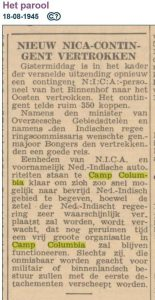
A contemporary report published in Het Parool on 18 August 1945 stated that NICA units and Netherlands Indies officials at Camp Columbia were standing ready to proceed as quickly as possible to liberated territory. Initially, only those considered indispensable for military or civil administration were to be sent.
Importantly, this did not mean that NICA simply abandoned Camp Columbia after the Japanese surrender. The same report stated that a substantial organisation was expected to remain functioning at the camp for some considerable time.
The transfer was therefore gradual. Camp Columbia continued to provide administrative, organisational and logistical support while personnel and functions were progressively shifted back towards the Netherlands East Indies.
At the same time, the political circumstances confronting NICA were changing dramatically. On 17 August 1945, Sukarno and Mohammad Hatta proclaimed Indonesian independence. What had been planned at Camp Columbia as the restoration of civil administration after Japanese occupation was now becoming entangled with a much larger struggle over the political future of Indonesia.
The subsequent Indonesian Revolution increasingly moved NICA’s history away from its Australian origins and into the history of Dutch-Indonesian decolonisation. That wider story is covered in the DACC Research Portal.
The end of NICA’s Camp Columbia phase
During the following months, the centre of NICA’s activities progressively shifted from Australia back towards the Netherlands East Indies.
Camp Columbia nevertheless remained important during this transition. Dutch and Netherlands Indies military and civilian personnel continued to use the camp, while it increasingly also accommodated evacuees and families displaced by the war and the unsettled conditions in the archipelago.
NICA itself continued operating in the Netherlands East Indies under changing Allied command arrangements. Its experience varied considerably between regions. In Borneo and parts of eastern Indonesia, NICA was able to establish administration behind Allied forces. On Java and Sumatra, however, the emergence of the Indonesian Republic made the attempted restoration of Dutch authority increasingly contested.
Those developments belong primarily to the history of the Indonesian Revolution rather than to the history of Camp Columbia.
In Australia, the remaining Netherlands Indies establishment at Wacol steadily contracted. By early 1946 Camp Columbia’s role had shifted increasingly towards accommodation, welfare and repatriation. On 1 May 1946, the closure of the remaining Netherlands Indies service and evacuee camp was announced.
No precise date has yet been identified for the formal departure of NICA headquarters itself. The surviving evidence instead points to a progressive transfer of personnel and functions beginning after Japan’s surrender and continuing as the Netherlands Indies administration re-established itself in the archipelago.
Camp Columbia’s role as NICA’s Australian headquarters had therefore come to an end, even though the wider Dutch presence at the site continued for some time afterwards.
The last Dutch transport plane left Archerfield Airport in Brisbane in September 1947.
Camp Columbia’s NICA legacy
NICA’s presence at Camp Columbia represents an important but often overlooked part of Brisbane’s wartime history.
From Wacol, Netherlands Indies officials prepared for one of the most difficult tasks confronting any government displaced by war: returning to territory from which it had been expelled and attempting to restore civil administration while military operations were still continuing.
Camp Columbia provided the headquarters, accommodation, training facilities and connections with other Netherlands Indies organisations needed to support that effort.
The surviving record also reveals the people behind the organisation. The ANRI NIGIS photographic collection identifies NICA personnel working in offices at Camp Columbia, officials studying locations in the Netherlands East Indies, transport staff discussing movement orders and administrative personnel carrying out the everyday work required to send people and supplies northwards.
These photographs complement the surviving Australian records. Together they show that Camp Columbia was not merely a place where plans for the postwar Netherlands East Indies were discussed. It was a working headquarters from which personnel were prepared, organised and dispatched into areas being recovered from Japanese occupation.
NICA’s later history became inseparable from the Indonesian struggle for independence. But its Australian phase remains an important part of the Dutch-Australian wartime story.
For approximately two years, Camp Columbia was one of the places from which the Netherlands Indies authorities attempted to organise their return home.
Sources and further reading
For the sources, I would use essentially the same disciplined approach as for NEFIS, but with the NICA-specific material:
- Nationaal Archief, The Hague — Netherlands Indies Government and NICA records concerning civil administration, personnel, Allied agreements and operations in recovered territory.
- National Archives of Australia — records concerning the Netherlands Indies Government-in-Exile and its establishment at Camp Columbia. NAA records confirm that the NEI Government began moving to Camp Columbia in August 1944.
- Australian War Memorial, Allies in Adversity: The NEI Government-in-Exile — background to the concentration of Netherlands Indies government and military organisations at Camp Columbia, where eventually about 2,000 military and civilian personnel were based.
- Arsip Nasional Republik Indonesia (ANRI), Inventaris Arsip Foto Netherlands Indies Government Information Service (NIGIS): Seri Wilayah Australia 1930–1946 — particularly valuable for photographs documenting NICA offices, personnel and administrative activities at Camp Columbia. Catalogue entries 1179–1184 include NICA officials and staff at the camp.
- Het Parool, 18 August 1945, “Nieuw NICA-contingent vertrokken” — contemporary evidence of NICA personnel preparing at Camp Columbia for deployment to liberated Netherlands Indies territory.
- Camp Columbia Heritage Association research — including material on the Dutch-period buildings and facilities, NICA headquarters, civil-relief preparations and the Camp Columbia timeline.
Then add Related articles with links to the DACC NICA research article and the CC article Camp Columbia and the Training of Dutch Officers for the Netherlands Indies and New Guinea.