
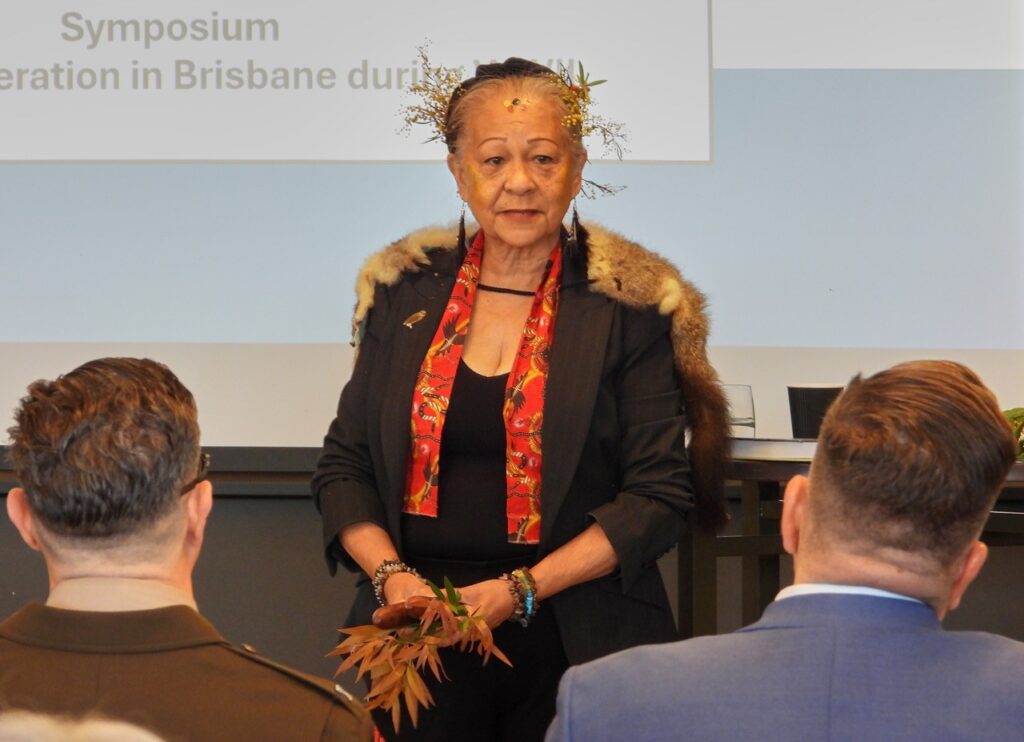
When Aboriginal elder Aunty Theresa Williams opened the Camp Columbia WWII Symposium in August 2025, she spoke not only as a Traditional Custodian welcoming participants to Country, but also as someone with a personal connection to Wacol. In her remarks, she recalled that she and her family lived for a period at the Wacol migration camp during the 1950s.
For many attending the symposium, this was unexpected. Wacol is most often remembered as a former wartime military site and, later, as a migrant accommodation centre. Aboriginal residence at Wacol has rarely featured in public histories. Aunty Theresa’s testimony therefore adds an important Aboriginal perspective to the post-war story of the Camp Columbia landscape.
Aunty Theresa is a respected Brisbane Aboriginal Elder who regularly provides Welcome to Country and cultural guidance at civic, community and heritage events. Her position as an Elder reflects long-standing community recognition grounded in cultural authority, responsibility to Country and the transmission of intergenerational knowledge. Within Aboriginal traditions, oral history is a vital means of preserving experiences that were seldom recorded in official documents, particularly in the post-war period.
Her recollection of living at the migration camp aligns closely with contemporary evidence showing that Wacol functioned in the early 1950s as a shared housing and integration site. At that time, former wartime huts were used to accommodate a mixed population that included migrants, Australian-born families and Aboriginal residents. Aboriginal people living at Wacol were often described in the language of the period as “coloured” or as “exempt” Aboriginals, terminology that obscured identity while reflecting prevailing racial policies. She stayed her until December 1957.
Subsequent research has shown that Aunty Theresa’s story sits within a much deeper Aboriginal history connected to the Camp Columbia landscape. Historian Dr.Ray Kerkhove had already documented traditional Aboriginal camps across the Brisbane region in his book Aboriginal Campsites of Greater Brisbane . The campsite closest to Wacol identified in his work was located in the Goodna area.
Based on personal interviews conducted by Camp Columbia researchers with Aboriginal Elders, the area that later became Camp Columbia was identified as part of a broader cultural and economic landscape. This included hunting grounds across the plains leading down to the Brisbane River, where fishing also formed an important part of Aboriginal subsistence and seasonal movement.
Building on this earlier work, Kerkhove later began examining Aboriginal accommodation in so-called “camps” established in former Second World War military sites. That research revealed that places such as Wacol were not isolated anomalies, but part of a wider post-war pattern in which Aboriginal families were housed in repurposed wartime infrastructure. This deeper context links directly to the documented Aboriginal presence at what had been Camp Columbia and by that time functioned as the Wacol Migration Centre. This history is explored in more detail in the accompanying article Aboriginal lives at Wacol: housing, assimilation and the post-war legacy of Camp Columbia.
Aunty Theresa has also noted a coincidental family connection that quietly reflects the intersecting histories of Wacol. Her sister later married a Dutch man in Eindoven and a second husband in Someren, she now (2026) lives in Brisbane.. While this is not directly related to Camp Columbia, it resonates with the site’s wartime role, when Dutch military and government personnel operated from nearby Camp Columbia during the Second World War. Across different periods, Aboriginal, Australian and European lives intersected around Wacol, often through circumstance rather than design.
By placing Aunty Theresa Williams’ lived experience alongside contemporary documentation and longer-term Aboriginal history, the Camp Columbia Heritage Association recognises the importance of oral testimony in understanding how this landscape continued to shape lives long after the war ended. Her story ensures that Aboriginal experience is acknowledged as an integral part of Wacol’s post-war history and of the broader Camp Columbia legacy.