
Following the end of the Second World War, the Camp Columbia site entered a new phase in which its existing infrastructure was repurposed to meet a range of post-war needs. One of the lesser-known uses of these facilities was the establishment of the Wacol Housing Camp.
In Brisbane, one of the most pressing challenges was a severe housing shortage caused by population growth, returning servicemen, and the arrival of migrants. From 1947, the Queensland Housing Commission began using part of the former Camp Columbia site as a large temporary housing settlement, which became known as the Wacol Housing Camp. At the same time, from 1949 onwards, the Commonwealth Department of Immigration established the Wacol Migration Centre on adjacent sections of the site, using the same former military infrastructure to accommodate displaced persons and new arrivals to Australia.
These developments took place alongside the continued presence of the military, which retained control of portions of the former Camp Columbia area for training and operational purposes. As a result, Wacol evolved into a layered post-war landscape in which military, housing and migration functions coexisted.
While these uses were administratively separate, they shared the same physical environment. Residents experienced the area as a single camp complex, where migrants, Aboriginal families and Australian-born residents lived in close proximity within repurposed wartime huts. This overlapping use marked the beginning of a new chapter in the history of the site, linking its wartime role directly to the social and demographic transformations of post-war Brisbane.
Establishment of the Wacol Housing Camp
In 1947, the Queensland Housing Commission leased land at the former Camp Columbia site from the Australian Army to create temporary accommodation for families unable to secure housing in the private market. The Commission, established in 1945 under the State Housing Act, had been tasked with addressing the acute shortage of affordable housing across Queensland. By the late 1940s, many families were living in improvised conditions, including tents, garages and converted wartime structures.
According to contemporary reporting, the State Government formally took over portions of the former United States Army Camp Columbia at Wacol in February 1947 for temporary housing purposes. Newspapers at the time reported that at least fifty families would initially be accommodated at the site.
At Wacol, existing army huts were adapted for civilian use. These buildings, originally designed for short-term military occupation, retained many of their basic features. Facilities were communal, with shared bathrooms and laundries, and services were minimal. Early reports indicate that even basic infrastructure such as street lighting was lacking, contributing to a sense of insecurity among residents, particularly women and children.
The camp was always intended as a temporary solution, but the scale of the housing shortage meant that it remained in use for well over a decade.
Growth and scale of the camp
The Wacol Housing Camp expanded rapidly in the years following its establishment. By July 1949, around 160 families were already living at Camp Columbia, and additional wartime buildings, including former headquarters areas, were being converted into housing units. By 1950, it is estimated that around 1,200 people were living at Wacol, making it one of the largest temporary housing settlements in Brisbane.
The 1954 census still recorded 889 people living in the Wacol Housing Camp, illustrating how long the temporary facilities remained in use. The final temporary housing camps in Queensland were not closed until the early 1960s.
The camp formed part of a broader network of Housing Commission camps across the city, with approximately a dozen such sites established to manage demand. However, Wacol stood out due to its size, its location within the former Camp Columbia complex, and its continued use of extensive wartime infrastructure.
The population of Wacol reflected the diversity of post-war Brisbane. Residents included Australian-born families facing economic hardship, recently arrived migrants, and Aboriginal families who were often excluded from mainstream housing options. In practice, Wacol functioned as a mixed community, bringing together groups who, under normal circumstances, would not have shared the same living environment.
Some Aboriginal people who had gained exemptions from government reserve controls moved to the housing camp as part of their transition to urban life. After the closure of the camp, an Aboriginal Hostel was later established south of the migrant camp in 1976.
Wacol within the post-war housing system
The Wacol Housing Camp played a key role within the broader strategy of the Queensland Housing Commission. It acted as a transitional space, providing immediate accommodation while more permanent housing solutions were developed. During the early 1950s, the Commission began constructing large suburban housing estates, most notably at Inala. Many of the first tenants in these new developments had previously lived at Wacol, making the camp an important stepping stone in the post-war expansion of Brisbane’s suburbs.
In 1953, many Wacol families were allocated new Housing Commission homes in Inala. Reports at the time indicated that while many residents welcomed the opportunity, some were reluctant to leave because rents in the new houses were significantly higher than those charged in the camp.
Despite this transitional role, conditions at the camp were often difficult. The original huts were not designed for long-term habitation, and as the years passed they deteriorated. Contemporary reporting described overcrowding, limited privacy and basic living conditions. Nevertheless, for many residents, Wacol provided stability at a time when alternatives were limited or non-existent.
At the same time, residents also developed a sense of community. Contemporary accounts describe families planting gardens, organising community dances and cricket matches, and creating a village atmosphere within the camp. However, reports also referred to unemployment, feelings of hopelessness, crime, and complaints about deteriorating buildings and poor maintenance. In 1949 the Building Workers’ Union reportedly described some camp buildings as “the worst they had ever seen”.
A shared space of integration and exclusion
The mixed population at the former Camp Columbia Camp meant that it became a site where different post-war policies intersected. Migrants were expected to integrate into Australian society, while Aboriginal residents were subject to assimilation policies that aimed to reshape their social and economic lives. These processes were often discussed in similar terms and, in some cases, were implemented within the same physical space.
For Aboriginal families, Wacol represented both an opportunity and a constraint. It provided access to urban employment and services, but it also reflected the limited housing options available to Aboriginal people at the time. Contemporary reporting confirms Aboriginal residence at the camp and highlights the challenges faced by those attempting to establish themselves in the city.
The presence of individuals such as Cyril Richards, who spoke publicly about these challenges, illustrates how Wacol functioned not only as a place of residence but also as a site where issues of equality, rights and social inclusion were negotiated. Organised initiatives at the camp, including projects aimed at integrating Aboriginal and non-Aboriginal residents, further demonstrate that Wacol was not simply a passive housing site but an active environment of social change.
Decline and closure
By the mid-1950s, the Queensland Housing Commission began to reduce its reliance on temporary housing camps as more permanent housing became available. Families were gradually relocated to new suburban developments, and the population at Wacol declined.
The process of closure was gradual, and by the late 1950s the camp was in the process of being dismantled. By around 1960, the Wacol Housing Camp phase had effectively ended, although migrant use of adjacent parts of the former Camp Columbia site continued for several decades.
Legacy of the Wacol Housing Camp
The history of the Wacol Housing Camp is an essential part of the broader Camp Columbia story. It demonstrates how wartime infrastructure continued to shape civilian life long after the end of hostilities. The site transitioned from a major Allied military installation to a large-scale housing settlement and, in parallel, a migrant reception centre, while parts of the area remained in military use.
This layered history highlights the interconnected nature of post-war change in Brisbane. Housing shortages, migration and Aboriginal displacement were not separate issues but overlapping realities experienced within the same physical space.
Understanding Wacol in this way provides a more complete picture of Camp Columbia’s legacy. It was not only a site of wartime significance, but also a place where the social consequences of the war were lived out in the years that followed, shaping the lives of thousands of people who passed through its huts and temporary homes.
For forty years, Wacol provided a home for people who were struggling — and for those who were taking the opportunity to build a new life. That observation captures the important transition of Camp Columbia from a wartime military complex into a major post-war social landscape.
Paul Budde April 2026
The following information comes from local historian Brenda Koster.
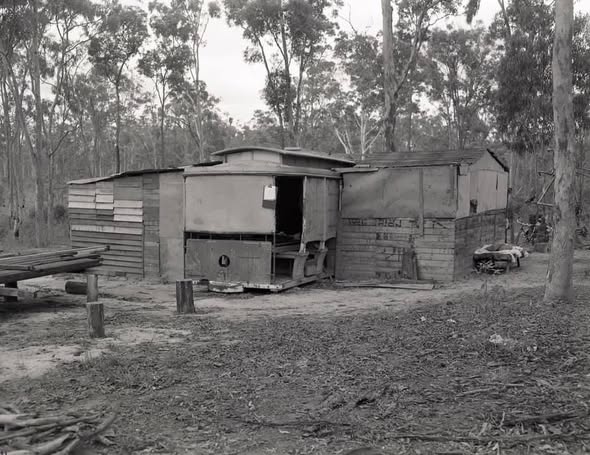
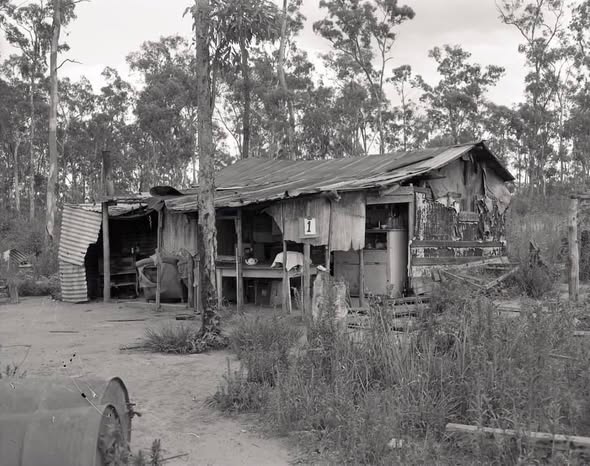
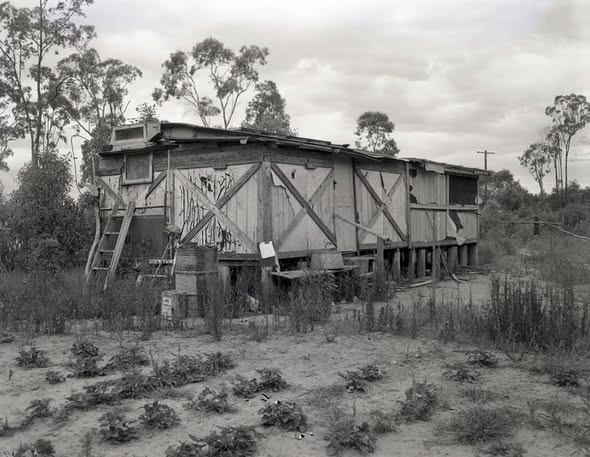
Temporary dwellings at Wacol, 1952, made from available materials.
The photos are from Brisbane City Council
A selection of temporary dwellings at Wacol, 1952. Most were made from any available material, some used old train carriages or trams. One of these images shows a brick painted canvas (?) facade, showing there was still some pride in adversity. There were many such dwellings at camps around Brisbane, including Tarragindi, some of which may have been occupied by ex WWII soldiers. My grandparents, who lived at Corinda, were registered with the Red Cross as a “drop in”, where itinerant men would be given a cup of tea and a scone – but they had to stay outside, at the bottom of the front steps. Brenda posted this on Facebook and there are also interesting comments on her post.
See also: Aunty Theresa Williams and Wacol: Aboriginal oral history from the migration camp