
During the Second World War, women served at Camp Columbia during both principal phases of its military history. American women were present while the camp was operated by the United States Army, followed from 1944 by women serving with the Dutch and Netherlands East Indies authorities.
The American women included military nurses attached to the medical units based at Wacol. The best-documented were the African American nurses of the United States Army’s 268th Station Hospital. Their story connects Camp Columbia with the wider history of wartime nursing, racial segregation in the American armed forces and the service of African American women in the Southwest Pacific Area.
This article concentrates on the American women. The later service of the Dutch and Netherlands East Indies women is explored separately in VK-KNIL Women at Camp Columbia: Training, Work and Personal Recollections.
American hospitals at Wacol
Camp Columbia and the surrounding Wacol military area supported a substantial American medical establishment. Units associated with the area included the 42nd General Hospital, 91st Station Hospital, 28th Surgical Hospital, 152nd Field Hospital and 268th Station Hospital, as well as the 13th Medical General Dispensary.
These were different types of military medical units rather than all being “field hospitals” in the formal sense. Together, they formed part of the medical system supporting American personnel in Australia and across the Pacific.
Nurses were essential to this work. However, surviving records tell us considerably more about some units than others. The women of the 268th Station Hospital can be connected directly with Camp Columbia through named photographs and archival records.
The nurses at Camp Columbia
Several surviving photographs enable individual nurses stationed at Camp Columbia to be identified.
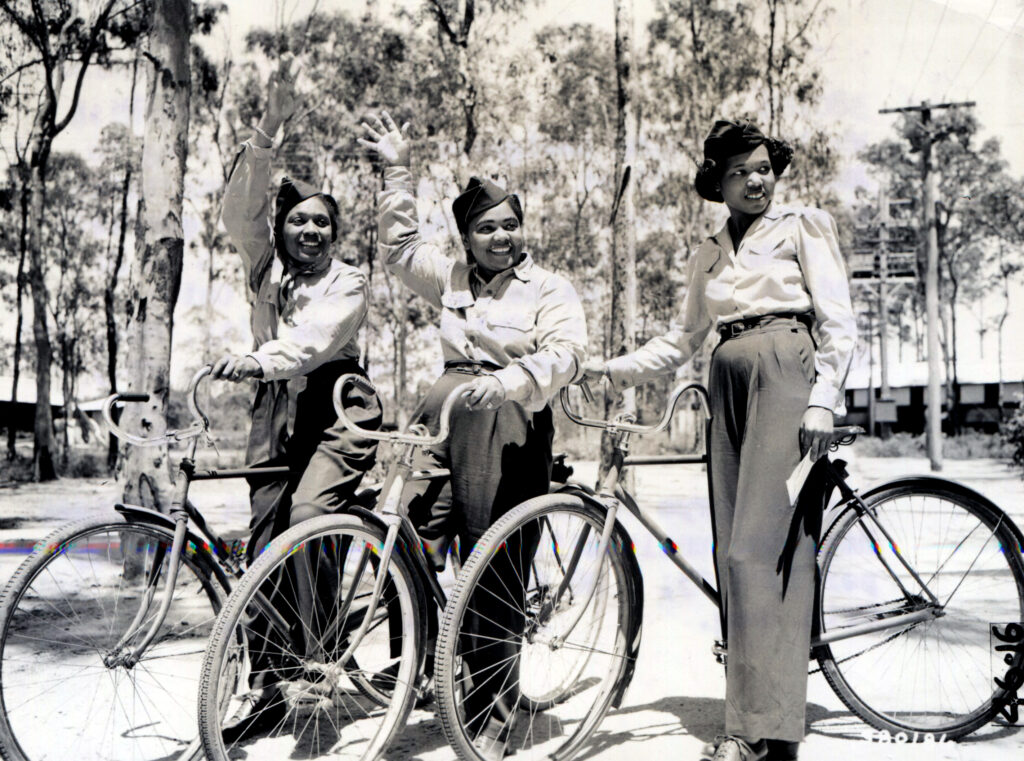
One photograph shows Second Lieutenant Beulah Baldwin, Second Lieutenant Alberta S. Smith and Second Lieutenant Joan S. Hamilton trying bicycles near their quarters at Camp Columbia. All three were nurses attached to the 268th Station Hospital.
The photograph is valuable not only as a military record but also because it captures a relaxed moment in the women’s lives. Far from home and preparing for service in New Guinea, the three friends are shown enjoying a bicycle ride within the camp.
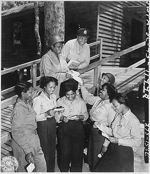
Another photograph, dated 29 November 1943, shows members of the nursing contingent receiving their first mail from home after arriving in the Southwest Pacific Area. Three of the women are identified as Lieutenant Prudence L. Burns, Lieutenant Inez Holmes and Lieutenant Birdie E. Brown.
These images restore names and individual identities to women who might otherwise appear in the historical record only as an anonymous group of American nurses.
Army nurses were not WACs
The American nurses should not be described as members of the American Women’s Army Corps. They were commissioned officers of the United States Army Nurse Corps.
The distinction is important:
- Army Nurse Corps officers provided professional nursing and medical care.
- Women’s Army Corps personnel performed administrative, communications, transport, clerical and technical duties.
- The Dutch and Netherlands East Indies VK-KNIL was a separate military organisation, although its members were sometimes informally called “Dutch WACs” in Australia.
American WAC personnel served at Yeronga Park and elsewhere within the large American military establishment in Brisbane. Given Camp Columbia’s administrative and headquarters functions, WAC personnel may also have worked at or visited Wacol. However, the evidence currently available does not establish that a permanent American WAC contingent was stationed at Camp Columbia.
We should therefore mention their possible presence cautiously rather than presenting it as an established fact.
From Camp Columbia to Milne Bay
Camp Columbia was one stage in the 268th Station Hospital’s wartime journey. The unit subsequently moved to Milne Bay in New Guinea, where its staff treated military personnel under difficult tropical conditions.
Malaria, dengue fever, scrub typhus, dysentery, skin infections and other tropical illnesses placed considerable demands on medical units. Nurses also treated personnel recovering from accidents, surgery and wounds sustained during operations elsewhere in the Pacific.
The work of the 268th formed part of the medical system that maintained the Allied advance. Although nurses did not normally serve as combatants, they often worked close to operational areas and under physically and emotionally demanding conditions.
Inez Holmes is one of the nurses whose later testimony helps document this experience. Her career and the wider significance of the 268th Station Hospital have been examined by the United States National Library of Medicine.
An important Camp Columbia story
The African American nurses of the 268th Station Hospital represent an important but insufficiently recognised part of Camp Columbia’s history. They served as trained military professionals while confronting discrimination within the armed forces of their own country.
Their presence also broadens our understanding of Camp Columbia. It was not simply a headquarters occupied first by American men and later by Dutch personnel. It was a large working military community in which women served from the American period onward.
The nurses of the 268th Station Hospital were followed by other groups of women connected with the camp, including the members of the Dutch and Netherlands East Indies VK-KNIL. Together, their experiences reveal the important and varied contribution women made at Camp Columbia during the Second World War.
Sources and further reading
- 268th Station Hospital panorama at Camp Columbia
- African American Nurse Officers at Camp Columbia, 1943
- National Archives: African Americans during the Second World War
- National Archives: Black joy through federal records
- Inez Holmes: Nurse and Veteran
- The Army Nurse Corps during the Second World War